

Building Your Own Logistics Software: Start with MVP, a Full Platform, or a Pre-Built Solution?

Helen Barkouskaya
.5 min read
.22 February, 2026
Head of Partnerships
.5 min read
.22 February, 2026
If you’ve been in freight long enough, you’ve probably had this moment.
Someone is chasing a quote. Rates are in three different emails. One surcharge lives in an Excel file saved on someone’s desktop. The TMS handles shipments, but pricing still happens outside the system. The margin looks fine… until accounting checks it.
And then, just because the tools you’re using don’t reflect how your operation actually runs, someone says: “Why don’t we just build our own system?”
That’s where the real decision starts.
Now, do you:
Build a full logistics platform?
Start with something smaller?
Or use a pre-built solution and adapt it?
Let’s walk through the options using practical, real-world freight examples.
Why Logistics Software Is Harder Than It Looks
Logistics isn’t clean: carrier rates arrive as PDFs, Excel sheets, emails, sometimes even screenshots. Every customer negotiates differently. Every lane behaves differently. And pricing logic often lives in someone’s head.
Off-the-shelf systems try to standardise all of this. But most freight businesses aren’t standard.
So what happens? You buy software that does 200 things, use maybe 20 of them, and still end up building workarounds in the system. Your team jumps between tools. Data gets copied manually. You pay for features you don’t need, while the parts that matter most still don’t quite fit.
That’s when building your own system starts to make sense.
Of course, not for “digital transformation”, but for commercial reasons:
Stop losing margin through small errors;
Reduce manual work that slows everything down;
Avoid hiring more people just to manage complexity;
To finally have software that supports how your business actually operates.
With that in mind, let’s look at the three realistic paths.

Three alternatives to ready-made logistics software: MVP custom development, full platform development, and pre-built solutions.
Three main options
So what do companies usually do at this point?
Some start small, fixing one expensive workflow and building from there. Others commit to a full platform because several teams already depend on the same systems and everything is clearly mapped. And some choose pre-built software when speed matters more than flexibility.
Which path makes sense depends on where you are today.
If you’re feeling the pain in one specific area and want results quickly, starting with an MVP is often the most practical move.
If your processes are already well defined and you’re ready to replace multiple tools at once, a full platform can make sense.
And if your operation is fairly standard and you mainly want something running fast, a pre-built solution may be enough.
Option | What it usually means | Typical timeline | Typical budget | What you actually get | Main risk | Best for |
Logistics MVP | A custom-built solution focused on one core workflow (quoting, invoices, rates) | 8–12+ weeks | €15k–€70k (Aud $27,000 – Aud $126,000) | One working system that solves a real problem (for example automated invoice checks or faster quotes) | Limited scope at first | Teams with a clear pain point who want fast ROI |
Full Logistics Platform | Custom system covering multiple areas (TMS, quoting, billing, dashboards, integrations) | 6–12+ months | €70k–€350k+ Aud $126,000 – Aud $630,000+ | End-to-end platform replacing several tools | High upfront cost and long time before value | Companies with stable workflows and strong internal ownership |
Pre-Built Solution | Existing logistics software adapted to your business | 4–8+ weeks | €3k–€30k (Aud $5,400 – Aud $54,000) | Standard features like basic quoting, tracking, admin panels | Hard to adapt to complex pricing or unique workflows | Standard operations where speed matters most |
Choosing how to build your logistics software is a lot like deciding how to build a house.
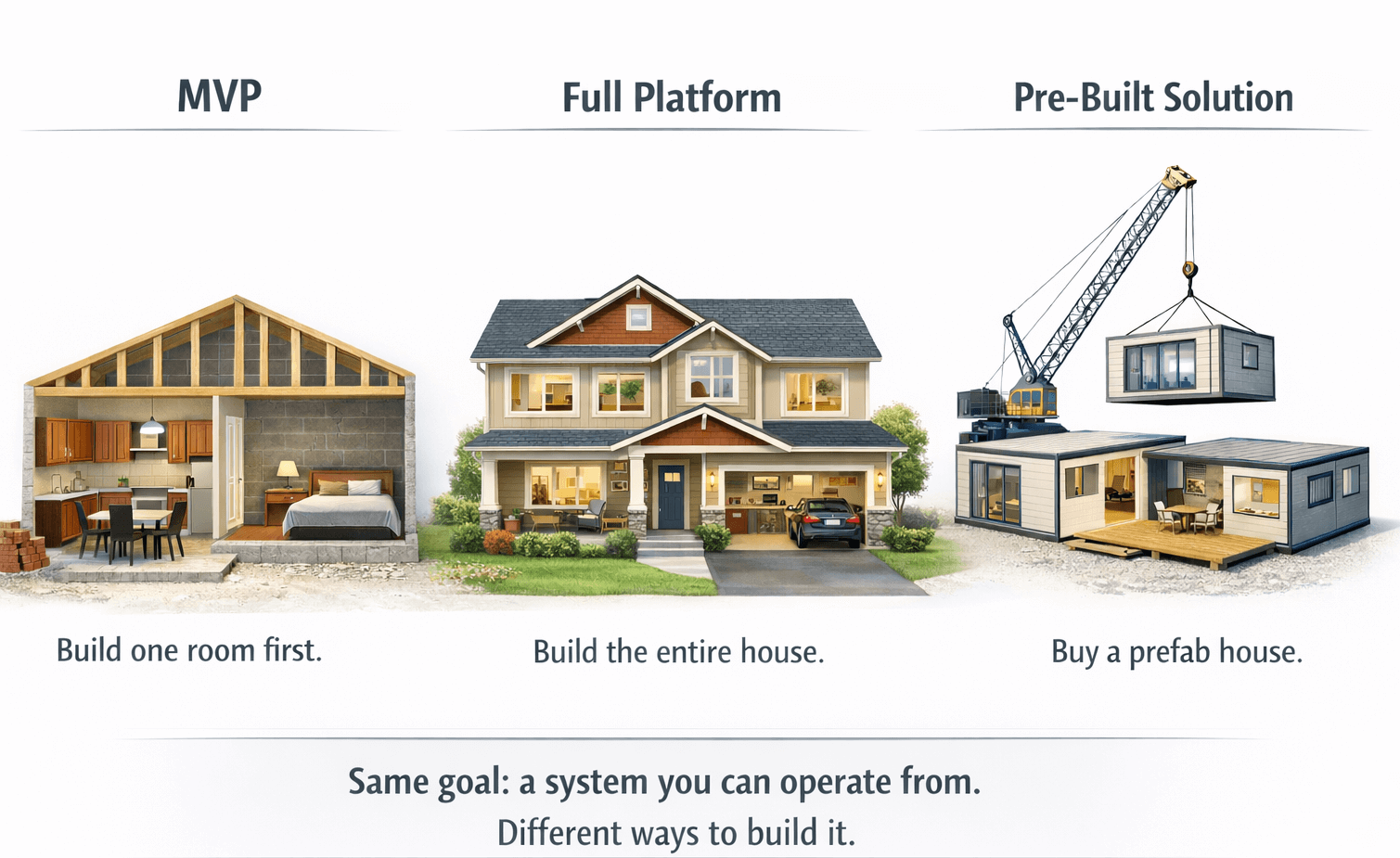
Logistics MVP vs full platform vs pre-built solution explained using a housing analogy.
You can start small by building just one room first, which is what a logistics MVP looks like: you fix one painful workflow such as invoice reconciliation or quoting, move in quickly, see value fast, and add more later once you understand what you really need.
You can also build the entire house at once, which is the full platform approach, where everything is designed upfront and delivered together. This only works well when your workflows are already stable, multiple teams depend on the same system, and you have the budget and patience to wait before seeing results.
Or you can buy a prefab house, which is similar to using a pre-built solution: most of the structure already exists, you adapt what you can, move in faster, and spend less upfront, but you accept limits if your pricing logic or processes are unique. Same goal in all three cases: having a system you can actually operate from. The difference is how much you build upfront, how quickly you move in, and how flexible you need things to be as your business evolves.
Option 1: Start with a Logistics MVP
A logistics MVP is simply the smallest system that solves one painful problem properly.
It isn’t a prototype or a demo: it’s a working piece of software that replaces manual work in one area.
In freight, it can be:
Rate normalisation
Margin calculation
Invoice checks
or any other feature or small set of functionality that fixes typically one challenge for your team.
Example - MVP for Freight Forwarding Team
John runs operations at AB Logistics.
Last month, while reviewing invoices with his finance team, he discovered they had lost around €3,000 to small billing inconsistencies: fuel surcharges that didn’t match contracts, fees that weren’t quoted, and rate changes nobody caught in time.
His team currently checks every third invoice. Not because they want to, but because they’re overloaded. Between quoting, customer requests, and daily operations, there’s simply no time to review everything manually.
John realized that if €3,000 slipped through while sampling invoices, checking all of them by hand would require hiring another person. That meant more cost and still more manual work.
Instead, he chose automation: he started with a small logistics MVP focused only on invoice reconciliation. The system imports carrier invoices, matches them against agreed rates and original quotes, flags discrepancies, and produces a simple reconciliation report.
Within weeks, his team moved from sampling invoices to checking every single one using the MVP functionality, and without adding headcount.
For John, this wasn’t about building a full platform, but instead about protecting margin and stopping money from leaking quietly. That’s what a freight software MVP looks like in real life.
When This Makes Sense
Start with an MVP when:
One problem is clearly costing you money
You want results in months, not a year
Your workflows are still changing
You’re not ready to replace everything
Most freight companies are here: they don’t need a platform, they need relief in one area. And once that works, expansion becomes easier, and safer.
Option 2: Build a Full Platform From Day One
This means building everything together:
TMS replacement
Quoting
Rate management
Integrations
Reporting
User roles and so much more.
It’s a serious investment.
This path usually works only when:
Your workflows are already stable
Multiple departments depend on one unified system
You’re replacing several disconnected tools
You have someone internally who truly owns the product
Here’s what often happens instead. A company tries to define everything upfront. Six months later, the business has changed: new requirements appear, users push back, adoption slows.
In logistics, you rarely understand the full system until people start using it.
That’s why skipping the MVP step can feel efficient at first, and painful later.
Option 3: Pre-Built Solutions
There’s also a middle path - pre-built logistics systems where most of the functionality already exists, and you customise what you need.
These usually include:
Standard quoting flows
Basic rate management
Shipment tracking
Admin panels, and more.
They’re faster to launch. Often cheaper.
But they come with limits: if your pricing logic is simple and your workflows are standard, this can work well. But if your competitive edge depends on complex pricing structures or unusual routing rules, you may hit walls quickly.
Pre-built tools are often a good stepping stone, especially if speed matters more than uniqueness. In this case, you may start with our modular solution for freight forwarding Freight-Strong, a highly flexible and precise tool powered by AI.
How We Usually Frame It for Freight Teams
Logistics MVP
You pick one expensive problem and fix it first.
Example: invoice reconciliation or quoting automation.
You usually see results within 2–3 months.
Savings start early.
You can expand later.
Full Platform
You replace several systems at once.
You wait longer before seeing value, but end up with a broader solution.
This only works well when processes are already clear and someone inside the company owns the product long term.
Pre-Built
You move fastest and spend least upfront.
But once your pricing logic gets complicated or your workflows differ from the template, limitations show up quickly.
What Works Best in Practice
Most freight companies don’t jump straight to a full platform.
They follow something like this:
Fix one workflow (usually quoting or rates).
Extend into adjacent areas (margins, visibility, billing).
Connect everything once the foundations are stable.
That approach respects how logistics businesses actually evolve.
You learn from real usage instead of guessing.
How to Decide
Before you decide what to build, take a step back and look at your own operation:
Where does your team lose the most time every week?
Where do small mistakes quietly eat into margin?
What part of the workflow causes the most frustration day to day?
And if you could improve just one thing in the next 3-9 months, what would actually make a noticeable difference?
The answers to those questions should guide your starting point. And all the rest - technology trends, niche buzzwords, what competitors claim they’re building - don’t matter. It is your team and your own bottleneck that matters.
Final Thought
Building logistics software isn’t about becoming a tech company.
It’s about regaining control over:
Pricing
Data
Processes
Margins
Start small if you need to, go bigger if you’re ready, and use pre-built if speed matters more than flexibility. But don’t build everything at once just because it sounds impressive. In logistics, steady and practical usually wins.
How Whitefox Helps
At Whitefox Cloud Consulting, we work across all three paths delivering customized software for logistics.
Some teams come to us with one painful workflow and start with a logistics MVP. Others are ready to replace several systems and build a full platform. And in some cases, we help companies adapt pre-built solutions when speed matters more than customisation.
There’s no single model we push. We start by understanding where your operation is losing time or margin, then help you choose the smallest step that delivers real business impact. From there, we can scale gradually or move faster, depending on what your team is ready for.
If you’re exploring your options and want to sanity-check your approach, you’re welcome to reach out. A short conversation is often enough to clarify what makes sense for your situation.
Ready to Modernize Your Freight Operations?
Let’s talk about building an AI-powered quoting engine for your team.
