

Hiring a Dedicated Software Development Team Is Easy to Get Wrong (Here’s the Fix)

Most people think the hard part is “finding developers”.
It’s not.
The hard part is building a dedicated software development team that ships fast, stays aligned, and doesn’t rot into meetings, politics, and low output as the company grows. That problem is leadership and operating model, not just recruitment.
Whitefox’s view is simple:
Big projects don’t need big teams. They need small, scary-good, cross-functional teams with an efficient process.
And to set that up, you need real CTO-level experience—especially if you’re remote, in a regulated industry, or scaling fast.
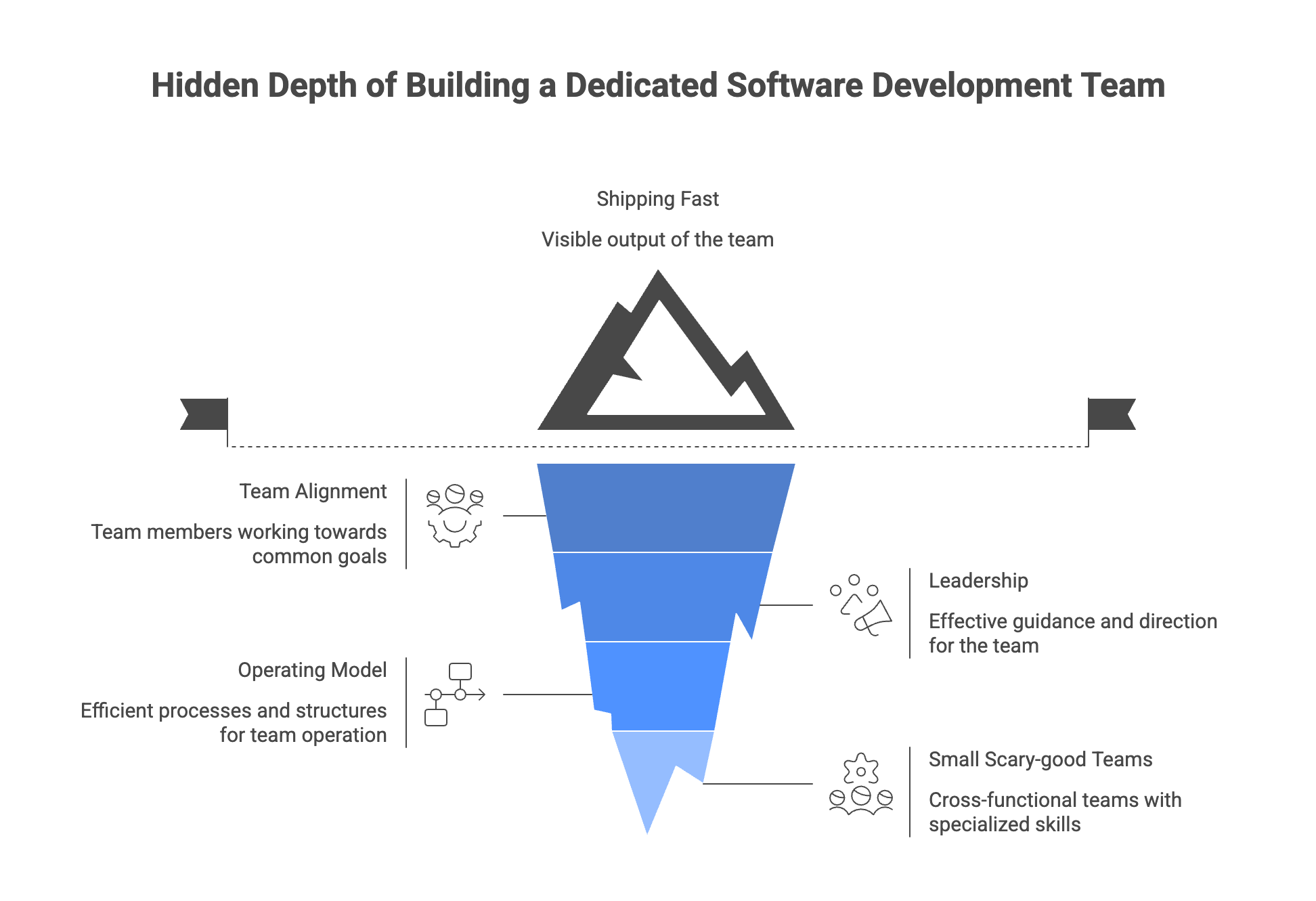
Shipping fast is only the visible result — real performance comes from alignment, leadership, operating models, and cross-functional teams underneath.
If you can’t afford a full-time CTO (or can’t find the right one), the only reasonable option that doesn’t compromise quality is a seasoned fractional CTO—someone who has done this before, repeatedly, at scale.
Why dedicated teams fail: headcount grows, speed doesn’t
As companies grow, delivery speed often stays flat (or gets worse). You see more layers, more committees, more “alignment” meetings, and still… average output from great people.
That’s not just annoying. It’s existential.
Speed is competitiveness. Research shows that companies in the top 25% of Developer Velocity outperformed the bottom 25% by up to 5 times on revenue growth.
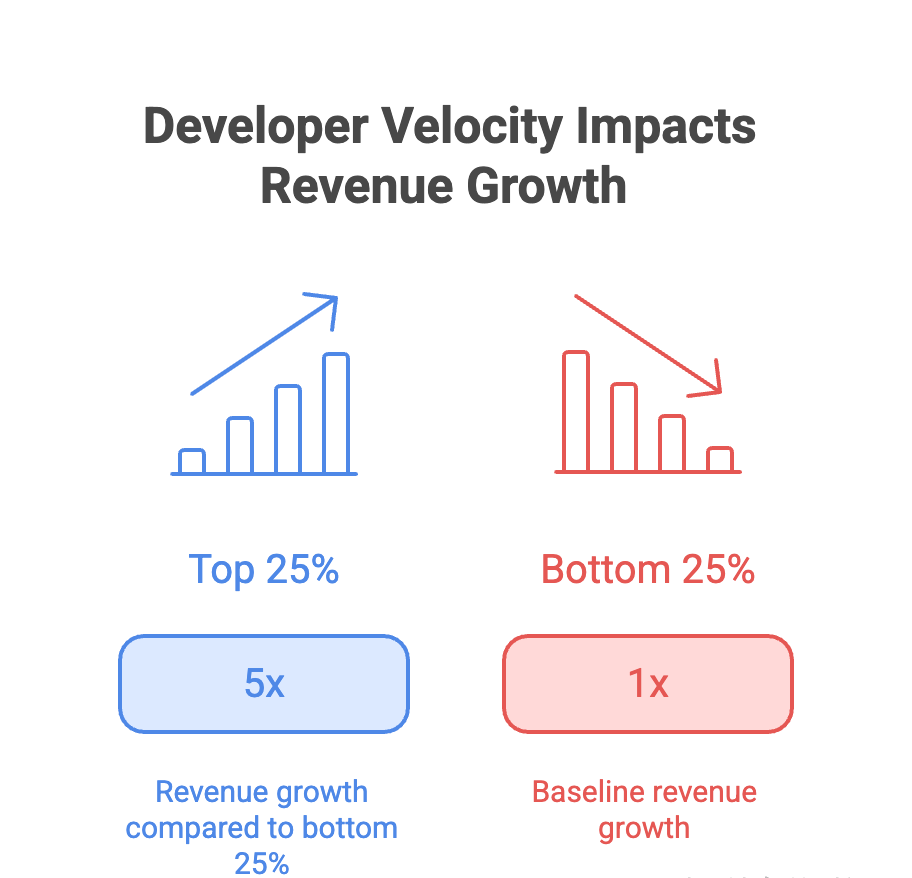
Top engineering teams grow revenue up to 5x faster than bottom performers — developer velocity directly impacts business results.
A founder who wants to hire dedicated software development team for startup is usually trying to turn urgency into momentum without cutting corners that will hurt later. The goal is a team that can build the right foundations, make hard trade-offs quickly, and ship in tight cycles—while keeping quality high enough that the product doesn’t collapse under its first real customers.
Teams looking to hire dedicated software development team for SaaS are typically chasing a steady release cadence without breaking reliability, security, and cost control. When the intention is to grow a subscription product, the “dedicated” part matters because you need continuity: people who understand the codebase, the customers, the operational risks, and can keep improving the product instead of constantly re-learning it.
When the intention is to operate in high-trust, heavily regulated environments, the needs get sharper. A company aiming to hire dedicated software development team for fintech or hire dedicated software development team for healthcare usually needs engineering discipline baked in—secure-by-default design, strong data handling, auditability, and compliance-aware delivery—without slowing everything down to a crawl. The point isn’t more capacity; it’s safe, consistent delivery under real constraints.
And when the intention is scale and complexity management, choosing to hire dedicated software development team for enterprise is often about predictable execution across many stakeholders, integrations, and non-negotiable service expectations. In practice, that only works when the team is set up with clear ownership and decision-making process to achieve dependable outcomes, not just a group of people assigned to you.
“Dedicated team” is an operating system, not a staffing model
A dedicated development team only works when a few things are true:
The team is small and cross-functional (not siloed frontend/backend/ops).
There is clear ownership end-to-end (API, UI, data, reliability, cost).
There is one decider—everyone has a voice, not everyone has a veto.
Delivery is engineered with CI/CD + IaC from day one, tracked via DORA metrics.
Meetings are replaced with strong asynchronous communication discipline, using tools such as Slack and MS Teams.
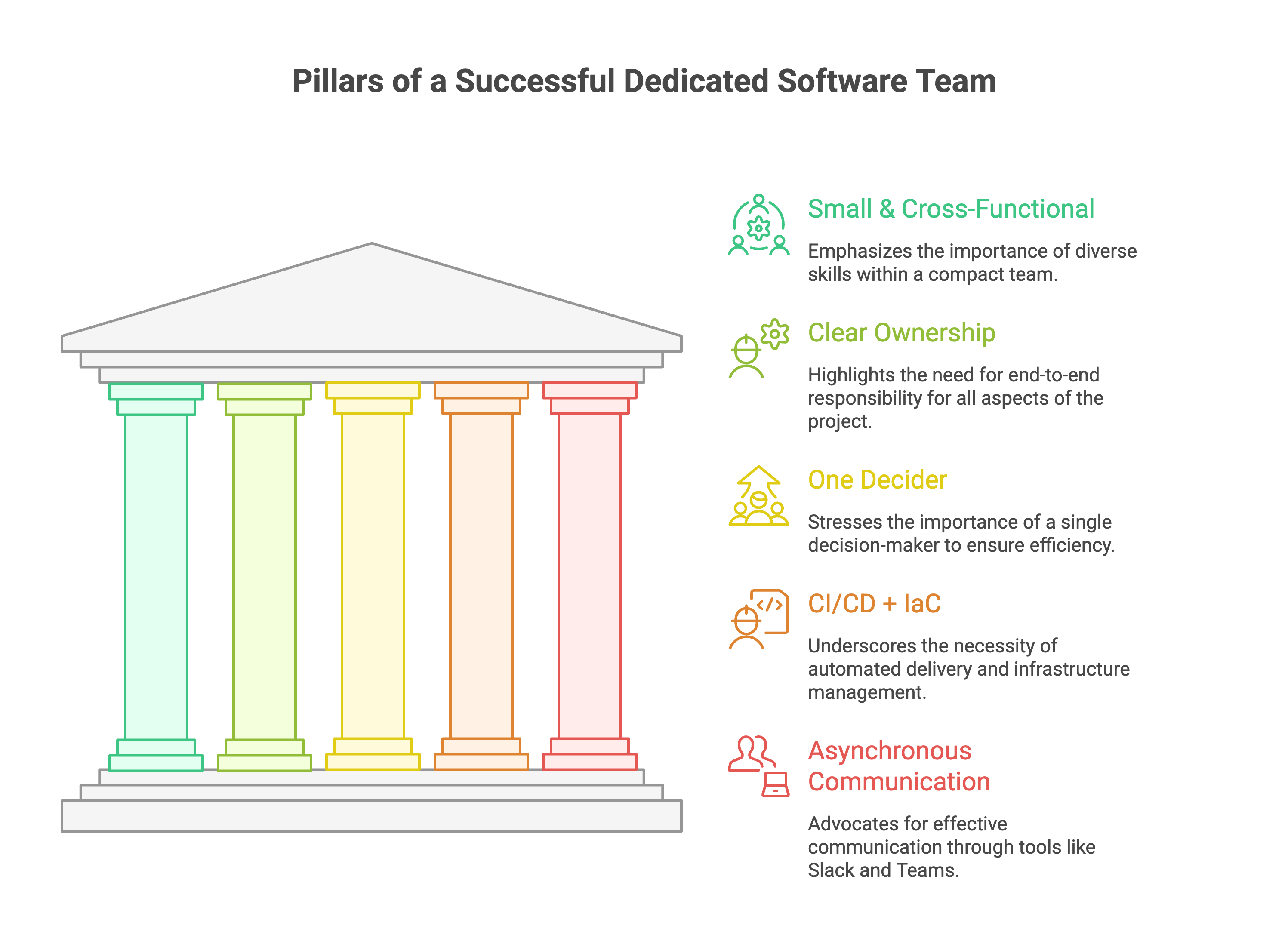
Five pillars that support high-performing dedicated software teams: ownership, autonomy, automation, and effective communication.
That “operating system” is what a strong CTO (full time or fractional CTO) actually installs.
Without it, you’ll pay for:
slow delivery
inconsistent quality
unclear accountability
brittle architecture decisions
death by meetings
“more devs ≠ more software shipped” dynamics
Why hiring a full-time CTO is harder than people admit
Even if you can afford a full-time CTO, it’s still hard to land the right one:
The best CTOs often don’t want to leave stable roles for your specific risk profile.
Many candidates can talk strategy, but haven’t built “tiny fast teams” that ship under real constraints.
In regulated industries (FinTech, HealthTech), the CTO has to balance delivery speed with compliance and security—without turning everything into a committee.
This is why a fractional CTO is not a “cheap CTO”.
It’s often the only realistic way to access a seasoned operator in a fractional setting—especially when you’re early-stage, pivoting, or scaling and don’t need (or can’t justify) a full-time executive.
The Whitefox model: tiny fast teams (4–7 people + AI)
Research often lands effective team size around 5–9 people. Whitefox’s operating stance is 4–7 people + AI, because communication overhead explodes beyond that.
This matters whether you want to hire a remote dedicated software development team, or outsource completely.
Note that remote/offshore adds a tax:
more coordination risk
more ambiguity
more opportunity for “not my problem”
Small, ownership-driven teams reduce that tax.
What a fractional CTO actually does when you hire a dedicated team
If you’re evaluating a dedicated software development team provider or dedicated development team agency, here’s what CTO leadership must put in place (or your “dedicated team” will behave like random contractors):
1) Team design: one backlog, one definition of done
“One team = one backlog” and a shared definition of done prevents fake progress and partial delivery.
2) Decision system: write decisions, don’t debate forever
Use short written proposals and ADRs that include context, options, and the final decision.
This is how remote teams avoid repeating the same arguments every month, and keep it documented for the future.
3) Async-first delivery rhythm (meetings down, messages up)
No daily stand-ups by default, one daily sync/async update, one weekly 1-hour session for planning/demo/unblock.
4) Delivery machine: CI/CD, IaC, DORA metrics
Automate build → test → deploy → rollback, then measure deployment frequency, lead time for change, failure rate, and MTTR. Have in mind that teams who deploy software quickly and reliably are happier.
5) Ownership and cost guardrails (not cost committees)
Set run-cost budgets, dashboards, alerts, and empower team leads to trade performance vs cost inside guardrails.
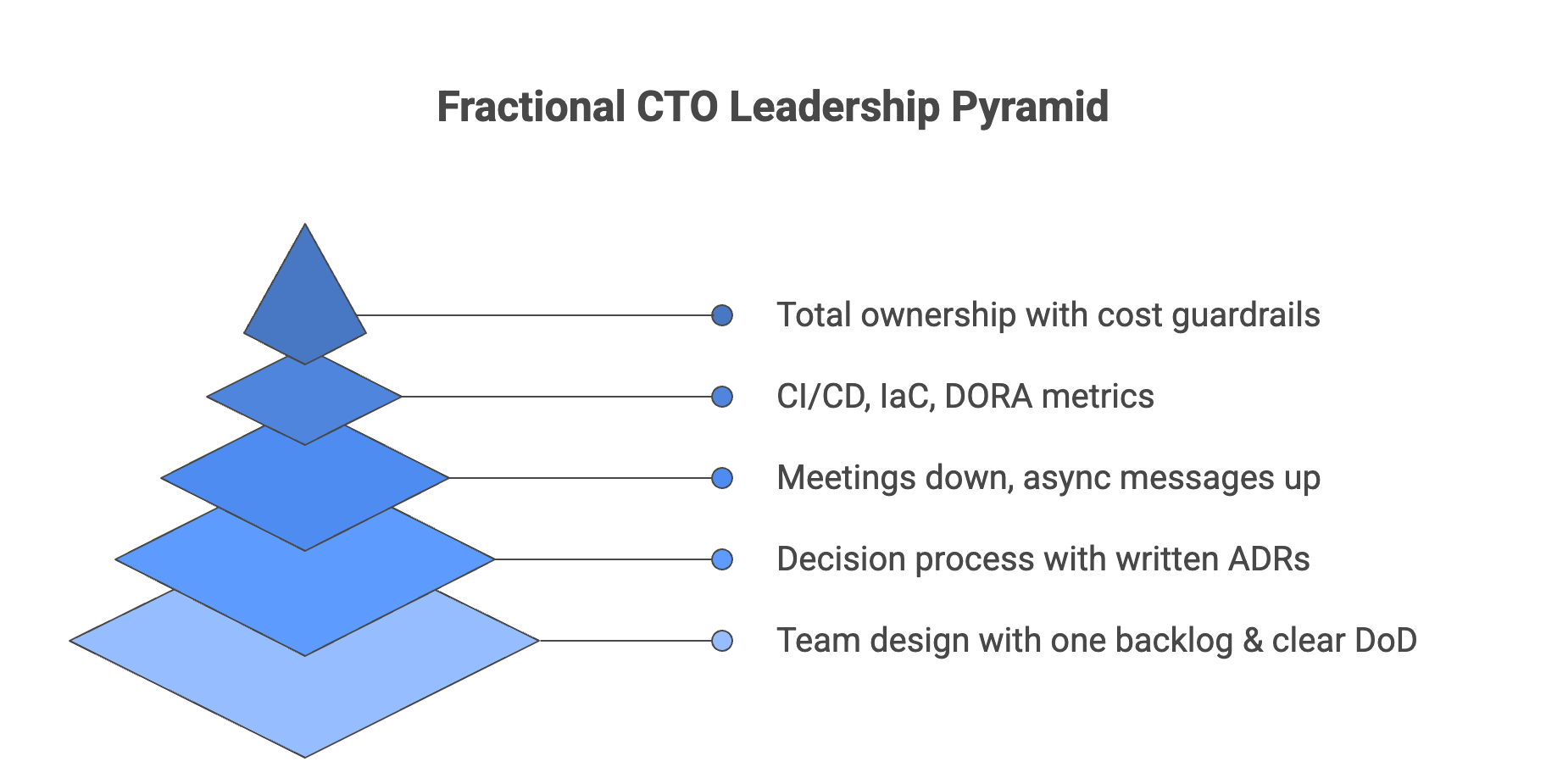
Pyramid of practices that a fractional CTO puts in place to have an efficient team instead of a random group of contractors.
Risks you should expect (and how to avoid them)
Small teams are fast, but they have known failure modes:
Risk: small teams become silos. Mitigate with shared platforms, standards, and cross-team channels.
Risk: “one decider” gets overloaded. Mitigate with clear scope, leadership support, and backup talent.
Risk: cutting meetings before building async discipline. Mitigate with a strong written culture and constant nudging.
A CTO’s job is to spot these early and correct them before they become cultural.
Pricing, cost, and rates: what you’re really paying for
The goal behind dedicated software development team pricing and dedicated software development team cost per month is usually simple: “What will this cost me to run, and can I budget it without surprises?”
People aren’t just comparing numbers — they’re trying to understand what’s included (seniority, roles, management, QA, DevOps) and what hidden costs show up later (rewrites, missed deadlines, unstable releases).
When someone cares about dedicated development team hourly rates, they’re typically weighing cost against control and risk. The question underneath is: “If I go cheaper, what do I lose — velocity, quality, communication, security, continuity?” Offshore can absolutely work, but only when the delivery model is tight and leadership is strong; otherwise the rate looks good while the total outcome gets way more expensive.
For local decision-making, dedicated team cost Australia often reflects a desire for timezone overlap, easier collaboration, and accountability — but with pressure to keep the cost sane.
And when people compare dedicated team cost vs staff augmentation or dedicated team vs project based development cost, they’re usually trying to pick the engagement model that reduces regret: augmentation if they already have strong leadership and need extra capacity, dedicated teams if they need continuity and ownership, and project-based when the scope is truly stable (which it rarely is).
Here’s the blunt reality:
The cheapest team is often the most expensive outcome.
If the team can’t ship reliably, you pay twice: once for building it, and again for fixing it (or rewriting it).Your biggest cost isn't the hourly rate. It’s cycle time + failure rate.
That’s why DORA-style delivery performance is not “engineering vanity”; it’s business leverage.Dedicated team vs augmentation: they solve different problems
Staff augmentation: fills skill gaps inside your current operating model.
Dedicated team: needs a completely new operating model (ownership, decision-making, delivery).
If you don’t have a great operating model in place, augmentation just amplifies chaos. Also, a dedicated team can become “outsourced confusion” if they don’t bring an efficient model with them.
A good fractional CTO helps you choose the right approach before you commit to it. This saves you a lot of costs upfront. Choosing the wrong approach easily turns into an expensive experiment that no cheap hourly rate can fix.
Australia focus: Sydney & Melbourne buyers—what to watch for
If you’re searching to hire dedicated software development team in Australia, Sydney, or Melbourne, you’re usually balancing three things:
Local accountability and timezone alignment
Access to scarce senior talent
Cost control (especially if you’re comparing offshore/nearshore)
A fractional CTO in Australia is the game changer before you decide on the team:
you keep strategic leadership local (and accountable)
you can still build a remote/offshore team safely
You avoid hiring the wrong full-time exec out of urgency — which is expensive not just in salary, but in lost opportunity.
Quick checklist: are you ready to hire a dedicated development team?
If you can’t answer “yes” to most of these, you need CTO leadership (fractional is just a way to find the right person without the delay and costs):
Do we have one clear decision owner for technical direction?
Do we have a plan for CI/CD + IaC from day one?
Do we measure delivery with DORA metrics and act on them?
Do we have an async operating rhythm (not meeting spam)?
Are our teams end-to-end owners of API/UI/data/reliability/cost?
How Whitefox helps
If you’re ready to hire a dedicated software development team but you don’t have the CTO bandwidth (or don’t want to gamble on a rushed full-time hire), a fractional CTO engagement is the practical middle path:
experienced leadership you can afford
faster setup with fewer mistakes
quality without executive overhead
We say 100 days is enough to see great results. If you want to move fast, we recommend starting with one critical product area and forming a 3–7 person cross-functional team with clear ownership, a single decider, measuring DORA metrics, and enforcing meeting/WIP limits.
Whitefox can lead that setup as your fractional CTO and delivery partner.
Ready to build your dedicated team the right way? Book a short call with Whitefox: we’ll map your first 100 days and define the exact setup that gets you to measurable results.
