
What is an API in software development? A practical guide for business teams

Key takeaway
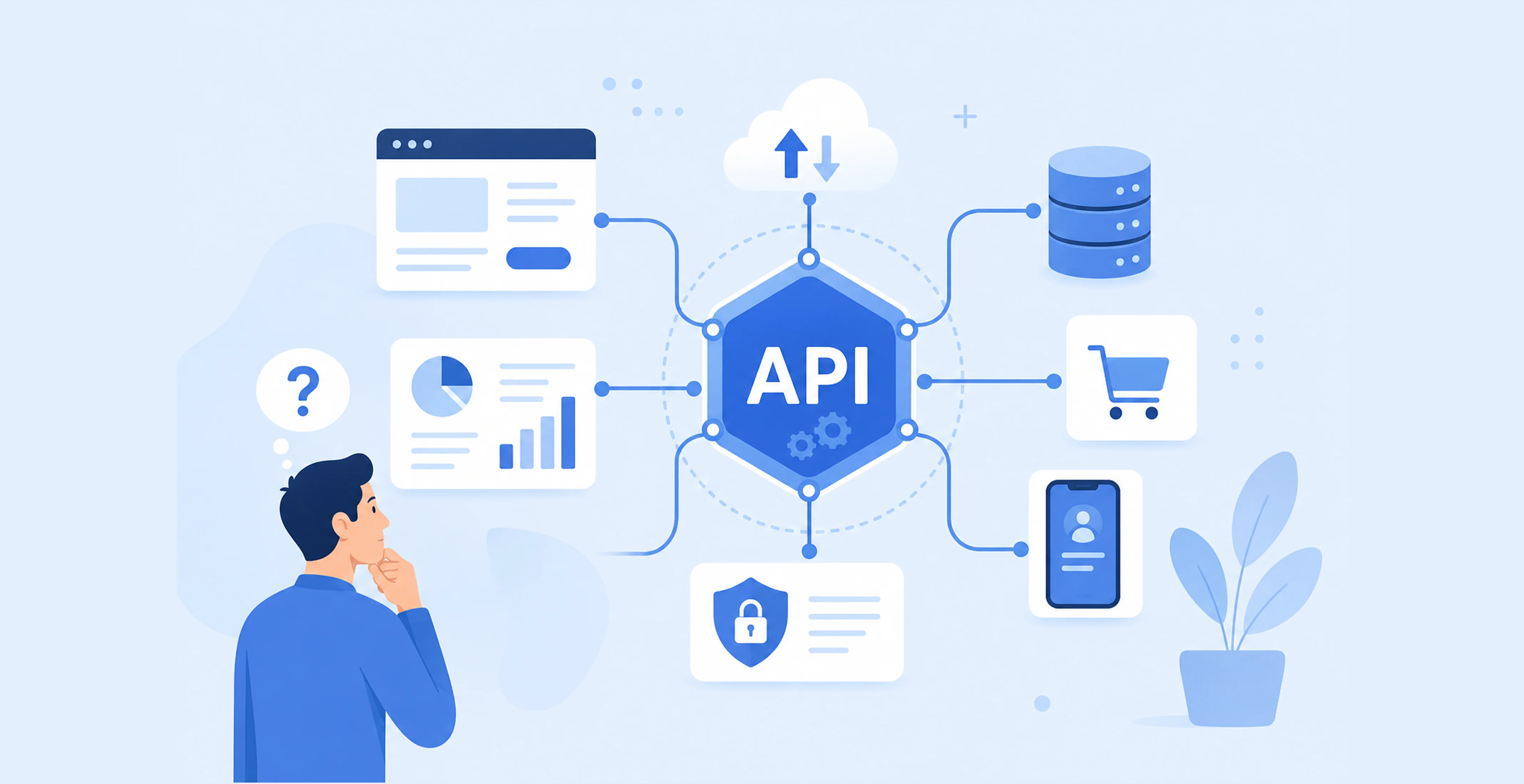
An API (Application Programming Interface) allows different software systems to communicate and exchange data.
API integrations help businesses connect existing systems without rebuilding everything from scratch.
REST APIs are the most common API architecture used in modern software development.
APIs power many everyday digital experiences, including online payments, customer portals, healthcare systems, and mobile apps.
When selecting an API development company, integration experience, security practices, and documentation standards often matter as much as coding ability.
Introduction
If you've ever made an online payment, logged into an application using Google, checked a shipment status, or viewed customer information inside a CRM, you've used an API.
APIs sit behind much of modern software. They allow systems built by different teams, companies, and technologies to exchange information reliably and automatically.
For business leaders, APIs are often discussed as a technical topic. In practice, they're usually a business topic. APIs determine how systems communicate, how workflows operate, and how easily organisations can connect new software to existing platforms.
So what is an API in software development, and why does it matter?
Let's start with the basics.
What is an API in software development?
An API (Application Programming Interface) is a set of rules that allows different software systems to communicate with each other. In practice, this is often described simply as a software API: a defined way for one application to exchange data or trigger actions in another.
Think of an API as a messenger between two systems.
One application requests information or asks another application to perform an action. The API receives that request, passes it to the appropriate system, and returns a response.
For example:
A mobile banking app requests your account balance.
The API sends the request to the bank's backend systems.
The backend retrieves the information.
The API returns the balance to the app.
The user sees the result almost instantly, but multiple systems are communicating behind the scenes.
Without APIs, software systems would struggle to share data efficiently.
How does an API work?
An API works by receiving a request, processing it, and returning a response.
Most APIs follow a relatively simple process.
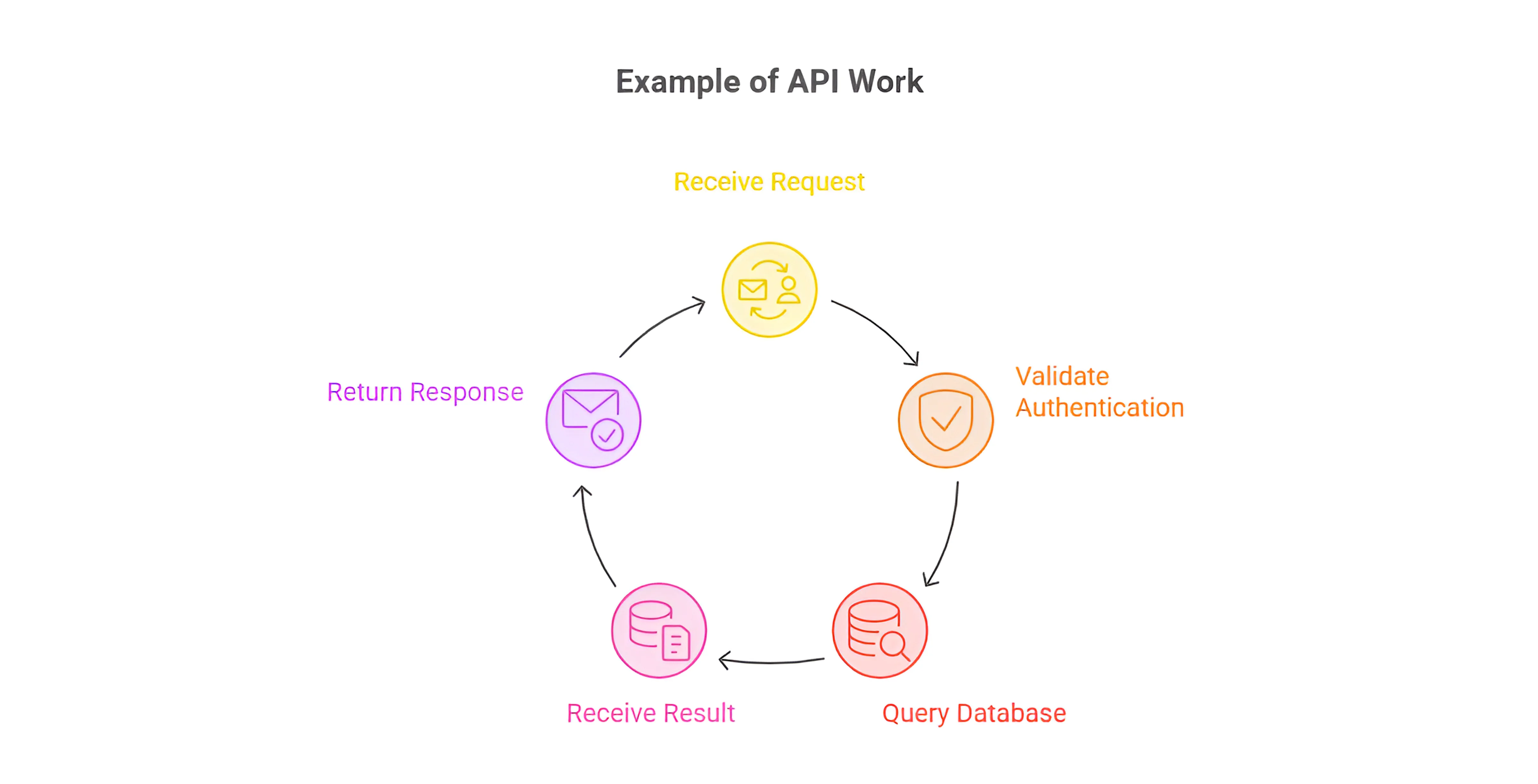
Example of how an API processes a mobile app request
API request
A request is sent from one system to another.
For example:
A website requests product information.
A CRM requests customer data.
A healthcare platform requests patient records.
The request typically contains:
The destination endpoint
The requested action
Authentication credentials
Required data parameters
API response
After processing the request, the receiving system sends back a response.
The response may include:
Data
Confirmation of an action
Error messages
Status information
API endpoints
An endpoint is a specific location where an API receives requests.
For example: /customers
/orders
/products
Each endpoint usually performs a specific function.
Authentication and security
Most APIs require authentication before data can be accessed.
Common approaches include:
API keys – A unique key assigned to an application that identifies who is making the API request. Commonly used for simple integrations and access control.
OAuth – A widely used authorisation framework that allows users to grant applications limited access to their data without sharing passwords.
Access tokens – Temporary credentials issued after successful authentication. Access tokens are included in API requests to verify that the requester is authorised.
Single sign-on (SSO) – Allows users to access multiple applications using one set of login credentials, improving user experience and reducing password management overhead.
Authentication helps ensure that only authorised users, applications, and systems can access API resources and data.
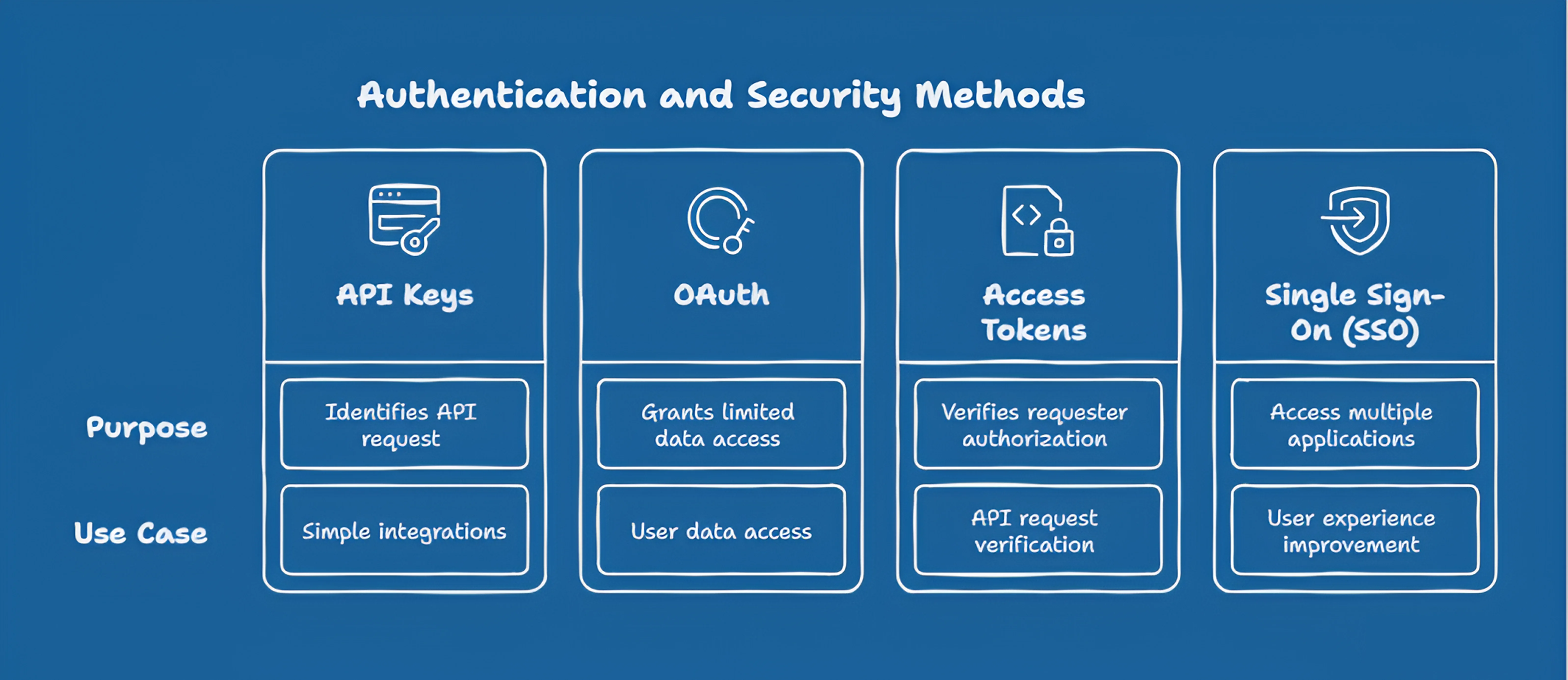
Comparison of API keys, OAuth, access tokens, and single sign-on (SSO), including their purpose and typical use cases in API security and integrations.
Authentication helps ensure that only authorised systems and users can access information.
What is the role of API in software development?
The role of APIs is to enable software systems to share data and functionality without building everything from scratch.
Modern applications rarely operate in isolation.
If APIs sound a little like digital messengers, that's because they are. One developer joke puts it this way: "What's the difference between an API and a teenager? The API usually responds to requests." Fortunately, well-designed APIs tend to be much more predictable.
A single platform might connect with:
Payment providers
CRM systems
ERP systems
Identity verification services
Analytics platforms
Messaging services
Rather than rebuilding those capabilities internally, organisations often connect existing services through APIs.
This approach can help:
Reduce development effort
Improve system interoperability
Accelerate delivery timelines
Support scalability
Simplify maintenance
For example, an e-commerce platform does not typically build its own payment processing infrastructure. Instead, it integrates with a payment provider through APIs.
What is API integration in simple terms?
API integration is the process of connecting two or more software systems so they can exchange information automatically.
Instead of employees manually moving data between systems, APIs allow software to handle that process in real time.
This reduces duplication and helps maintain consistency across systems.
What is API integration with an example?
Imagine a sales team uses a CRM to manage customer information.
When a deal closes, the CRM sends customer data to an accounting platform through an API integration.
The accounting system automatically creates a customer record and prepares billing information.
No one needs to re-enter the data manually. This workflow is a simple example of API integration.
What are API integrations?
Common API integrations include:
CRM and accounting systems
E-commerce and payment platforms
Healthcare systems and interoperability platforms
Logistics systems and carrier platforms
HR systems and payroll software
AI applications and business systems
For a deeper look at integration projects, see our guide to API integration services.
Real-world examples of API integrations
The easiest way to understand APIs is through practical examples.
Business process | API integration example |
|---|---|
Online payments | Website connects to payment processor |
Customer management | CRM synchronises customer records |
Healthcare interoperability | Clinical systems exchange patient information |
Logistics operations | Freight platform retrieves carrier rates |
Identity verification | Application validates customer identity |
AI workflows | Business platform connects to an LLM service |
Healthcare organisations frequently use APIs to exchange structured clinical information. This is one reason why FHIR integration has become increasingly important in digital health projects.
Similarly, many modern AI applications rely heavily on APIs to connect models, workflows, and operational systems. Our AI software development work often involves extensive API integration as part of larger workflow automation projects.
What are the 4 types of API?
The four commonly recognised API types are public APIs, partner APIs, private APIs, and composite APIs.
The four main API types are public APIs
Public APIs
Public APIs are available to external developers.
Examples include weather services, mapping platforms, and public data services.
Partner APIs
Partner APIs are shared with approved business partners.
Access is usually restricted through agreements and authentication controls.
Private APIs
Private APIs are used internally within an organisation.
These APIs often connect internal applications, databases, and operational systems.
Composite APIs
Composite APIs combine multiple API requests into a single operation.
This can improve efficiency by reducing the number of separate requests required.
What is the most common API type today?
REST (Representational State Transfer) APIs are the most common API architecture used in modern software development.
REST became popular because it is:
Relatively simple to implement
Widely supported
Scalable
Compatible with web technologies
Many SaaS products, mobile applications, and enterprise systems expose REST APIs for integration.
While alternatives such as GraphQL and gRPC have become increasingly popular in certain scenarios, REST remains the dominant approach for most business applications.
What are the main 5 API methods?
The most common API methods are GET, POST, PUT, PATCH, and DELETE.
Method | Purpose |
|---|---|
GET | Retrieve data |
POST | Create new data |
PUT | Replace existing data |
PATCH | Update part of existing data |
DELETE | Remove data |
For example:
GET retrieves a customer record.
POST creates a new customer.
PATCH updates an email address.
DELETE removes a customer record.
These methods form the foundation of many REST APIs.
What are the four most common REST API operations?
The four most common REST API operations are Create, Read, Update, and Delete.
These are often referred to as CRUD operations.
CRUD operation | Common API method |
|---|---|
Create | POST |
Read | GET |
Update | PUT or PATCH |
Delete | DELETE |
Consider a customer management platform:
Create a customer
Read customer details
Update customer information
Delete inactive records
Most business applications perform these same operations repeatedly.
How do you choose an API development company?
Selecting an API development partner involves more than reviewing technical skills.
The real challenge is often understanding workflows, integrations, business rules, and operational requirements.
Look beyond coding skills
Many API projects succeed or fail based on architecture and integration decisions rather than code quality alone.
A strong API partner should understand:
System architecture
Data flows
Security requirements
Operational workflows
Long-term maintenance
Ask about integration experience
Integration projects often involve:
Multiple vendors
Legacy systems
Data transformation
Complex business rules
These challenges frequently create more complexity than the API itself.
Review security practices
Security should be considered from the beginning of the project.
Ask how the company handles:
Authentication
Authorisation
Data protection
Logging
Monitoring
Understand how they handle legacy systems
Many organisations still rely on older systems that were never designed for modern integrations.
Ask for examples of projects involving:
Legacy databases
ERP systems
Industry-specific software
Third-party vendor platforms
Evaluate documentation standards
Good APIs require good documentation.
Documentation helps:
Future developers
Internal teams
Integration partners
Ongoing maintenance efforts
Ask for relevant case studies
Look for projects similar to your own environment and industry.
Reviewing case studies often provides more useful insight than reviewing technology lists.
If you're evaluating vendors, our API development services page explains the types of API and integration projects businesses commonly undertake.
Common API misconceptions
Several misconceptions appear repeatedly during API projects.
APIs automatically improve data quality
APIs move data between systems.
They do not automatically correct poor-quality data.
If inaccurate information exists in the source system, the API will often transfer that same information elsewhere.
API integrations remove manual processes
API integrations can reduce manual work, but workflow redesign may still be required.
Automating a poor process can simply move the inefficiency elsewhere.
API integrations are always simple
Many integrations appear straightforward initially.
In practice, complexity often comes from:
Business rules
Security requirements
Legacy systems
Data mapping
Stakeholder coordination
More APIs create better architecture
Adding APIs without a clear strategy can increase operational complexity.
The goal should be solving business problems, not maximising the number of integrations.
Conclusion
APIs are one of the foundational building blocks of modern software.
They allow systems to exchange information, automate workflows, and support digital experiences that users often take for granted.
Understanding what an API is in software development helps businesses make better technology decisions. Understanding API integration helps organisations connect systems more effectively and reduce operational friction.
When selecting an API development partner, focus on more than technical implementation. Integration experience, architecture thinking, documentation quality, security practices, and operational understanding often determine long-term success.
The best API project is rarely the one with the most endpoints. It's the one that solves a real operational problem while remaining reliable, secure, and maintainable.
