
AI Platform Engineering
AI Platform Engineering
Turning Data Into Intelligence
Turning Data Into Intelligence
Intro
AI Platform for automated road condition assessment using computer vision
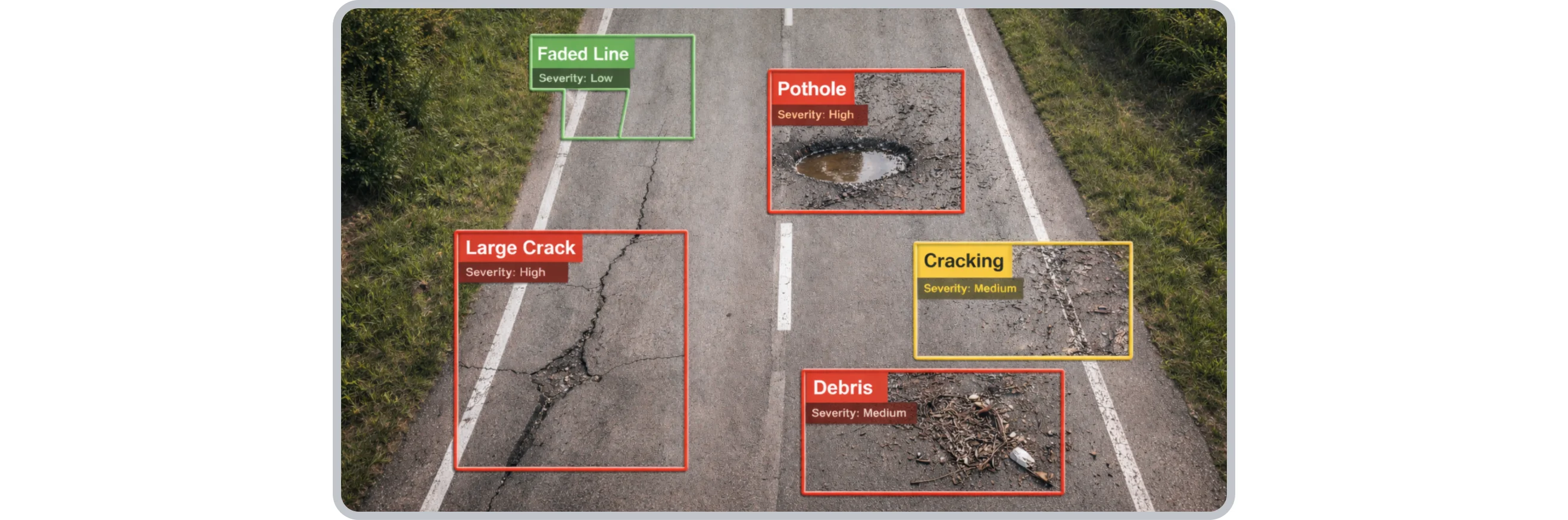
Shepherd Services operates road asset management systems that rely on large volumes of road imagery. Traditionally, identifying defects such as potholes, cracking, surface wear, and line fading required manual review or inconsistent interpretation.
Whitefox was engaged to build an AI system that:
Automatically detects road defects from captured imagery
Classifies each defect according to a domain-specific taxonomy
Measures defect magnitude and condition
Assigns a consistent, deterministic severity rating (1–5 scale)
Outputs structured, standardised data for integration into the RACAS® platform
We built a system that looks at road images, finds defects, evaluates how serious they are, and converts that into structured condition scores that engineers can use immediately.
The goal was not just detection, but repeatable, measurable, production-grade road condition intelligence at scale.
To deliver production-grade machine learning systems that convert unstructured data into structured, decision-ready intelligence, Whitefox built robust AI pipelines, validated model engines, deterministic scoring systems and cloud-native inference infrastructure, transforming raw data into trusted operational outputs.
The Challenge
Turning Raw Data into Production-Grade AI
Organisations often capture large quantities of high-value operational data (e.g., imagery, telemetry, logs, sensor streams) but struggle to translate it into actionable, consistent, real-world insight.
Common barriers to AI success include:
Unstructured data that cannot be automated
Generic detection models that lack domain alignment
Lack of deterministic scoring or business logic
Weak validation frameworks that don’t scale
Infrastructure that fails under production load
When Shepherd Services engaged Whitefox for the RACAS® platform, these challenges were evident: vast imagery datasets with no automated intelligence layer and no scalable way to standardise severity or condition outputs across tens of thousands of records.
Whitefox was brought in to transform this into a reliable, repeatable, production AI pipeline.
Our Approach
Engineering the Production AI Pipeline
We apply a structured AI engineering discipline — combining machine learning, software infrastructure and operational rigour.
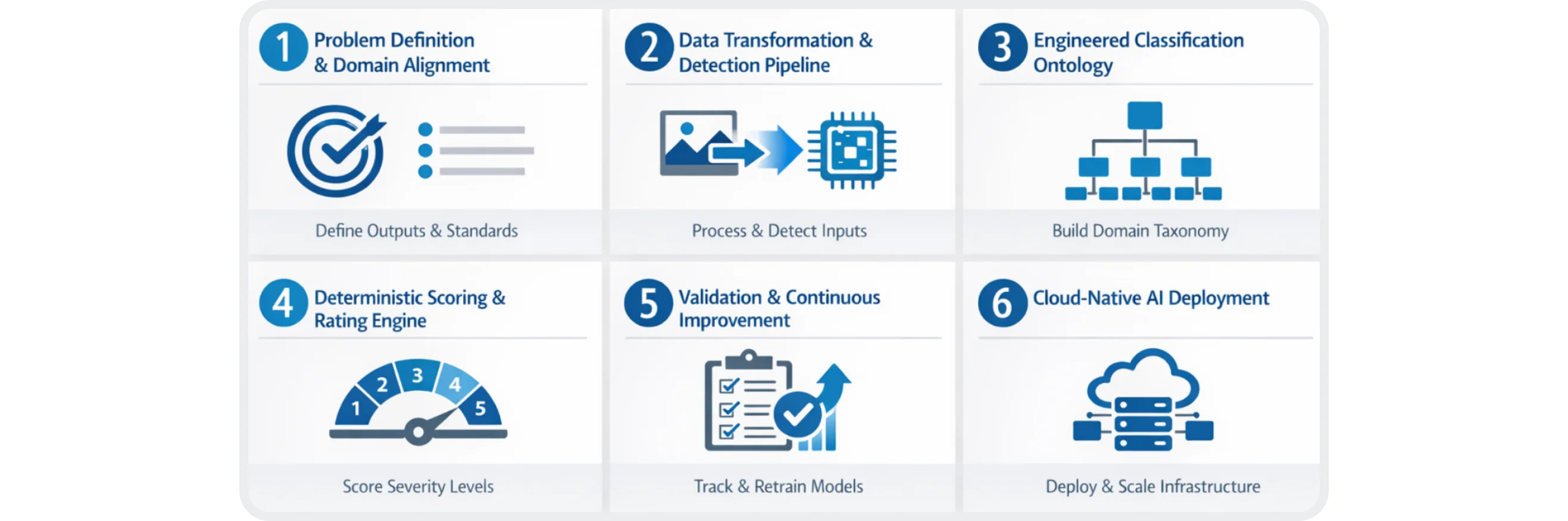
Step 1: Problem Definition & Domain Alignment
We worked closely with Shepherd’s product and technical teams to define:
What “useful output” looks like
What engineering standards to align to
What performance targets are required
What integration endpoints must be supported
This reframed the problem from “build a model” to “ship a production system.” We follow the intent-first mindset in building AI solutions, starting with what decisions users actually need to make, then engineering AI systems backwards from that intent.
Step 2: Data Transformation & Detection Pipeline
Raw unstructured inputs (e.g., imagery) were transformed into machine-readable formats using an automated AI pipeline:
Image preprocessing
Object detection architecture (YOLO format)
Bounding box generation
Confidence scoring and filtering
Structured export for downstream systems
This pipeline eliminated manual review and enabled continuous processing of new data.
Step 3: Engineered Classification Ontology
Rather than adopting generic labels, Whitefox built a hierarchical, domain-aligned classification structure, including:
Primary defect / feature classes
Secondary groupings based on risk or category
Explicit noise filtering classes
Confidence thresholds for model outputs
This ensured that machine predictions were interpretable and actionable by domain experts.
Step 4: Deterministic Scoring & Rating Engine
Detection alone does not equal intelligence.
Whitefox developed a custom rating engine that:
Converts model confidence into weighted scores
Applies engineered severity tables
Converts magnitude into 1–5 severity bands
Produces deterministic outputs for operational use
This means the AI outcomes were repeatable and defensible — not subjective.
Step 5: Validation & Continuous Improvement
We implemented a rigorous validation framework that:
Tracks performance by class (precision, recall)
Expands training data intelligently
Applies continuous retraining workflows
Tunes confidence thresholds for production use
This framework scaled from tens of thousands to hundreds of thousands of labelled examples while maintaining performance integrity. This validation framework incorporates best practices from Deep Dive into DeepSeek for Software Engineers, including structured evaluation routines and metric tracking that support continuous learning and model interpretability.
Step 6: Cloud-Native AI Deployment
AI at scale requires more than models — it needs infrastructure.
Whitefox designed and delivered:
Cloud inference clusters
Data transformation services
API integration layers
Secure, hosted environments
Monitoring and logs for production AI performance
This ensured the system operated reliably at scale without manual intervention.
Solution
Delivered: Production-Grade AI Systems
Whitefox delivered a complete, production-ready AI platform (not just isolated models) designed to operate reliably at enterprise scale. The system transforms unstructured inputs into structured operational intelligence, automatically detecting features and anomalies, assigning deterministic severity and condition scores, validating model performance, and integrating directly into RACAS through APIs. Built on cloud-native infrastructure, the platform scales without manual intervention and meets standards-driven enterprise requirements:
Converts unstructured data into structured intelligence
Detects features and anomalies with confidence scoring
Produces deterministic severity and condition scores
Validates model performance with engineering rigor
Integrates with operational platforms via APIs
Scales cloud-native without manual bottlenecks
Is ready for enterprise and standards-driven environments
This outcome is directly reusable for projects from other industries that require computer vision, predictive modelling, compliance systems, anomaly detection, geospatial analytics and more.
Before vs after
Business Outcome
Organisations that partner with Whitefox achieve measurable AI velocity increases:
Before Whitefox | After Whitefox |
|---|---|
Manual, inconsistent analysis | Automated, scalable inference |
Unstructured raw data | Structured, decision-ready outputs |
Prototype or pilot models | Production-grade AI systems |
Weak validation | Rigorous performance governance |
Ad-hoc infrastructure | Cloud-native, resilient pipelines |
Our work turns AI from an experiment into operational value.
The Impact
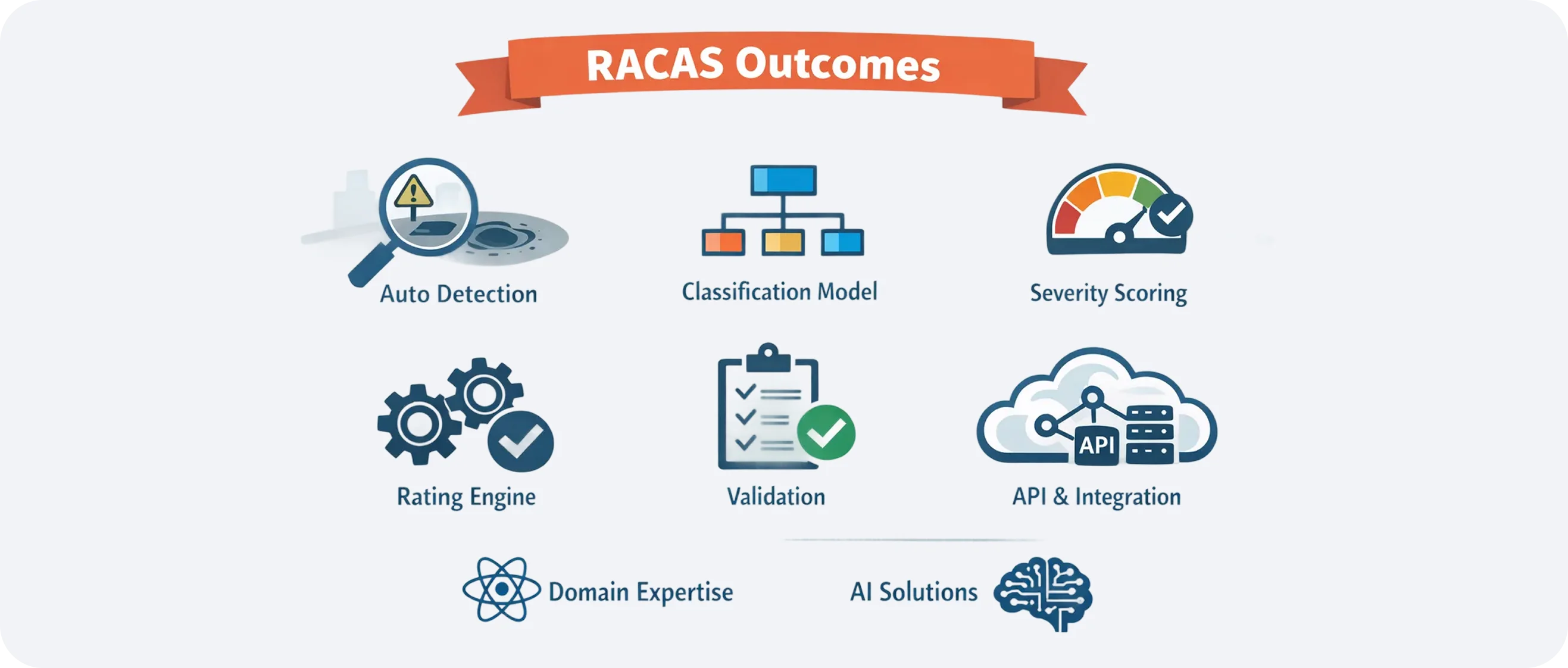
Key Outcomes from the RACAS Engagement
While the context was road asset management, the underlying AI engineering strategy is domain-agnostic.
Automated feature detection at scale
Domain-aligned classification ontology
Confidence-weighted severity scoring
Deterministic rating engines
Production validation framework
API and infrastructure integration
This reflects Whitefox’s deep AI engineering domain expertise, applicable across use cases and industries.
Architecture
Technical Highlights
Machine Learning & Computer Vision
Custom object detection pipelines
YOLO-derived architectures
Confidence calibration and filtering
Label hierarchy and ontology design
Model Governance
F1 performance tracking
Precision/recall balancing
Class-level error analysis
Continuous retraining workflows
AI Infrastructure
Cloud inference clusters (AWS, GCP)
Managed batch and streaming pipelines
API integration layers
Monitoring and logging at enterprise scale
Operational Integration
Export-ready structured data
Dashboard compatibility
API hooks into workflows
Compliance-ready outputs
Why us
Why Whitefox
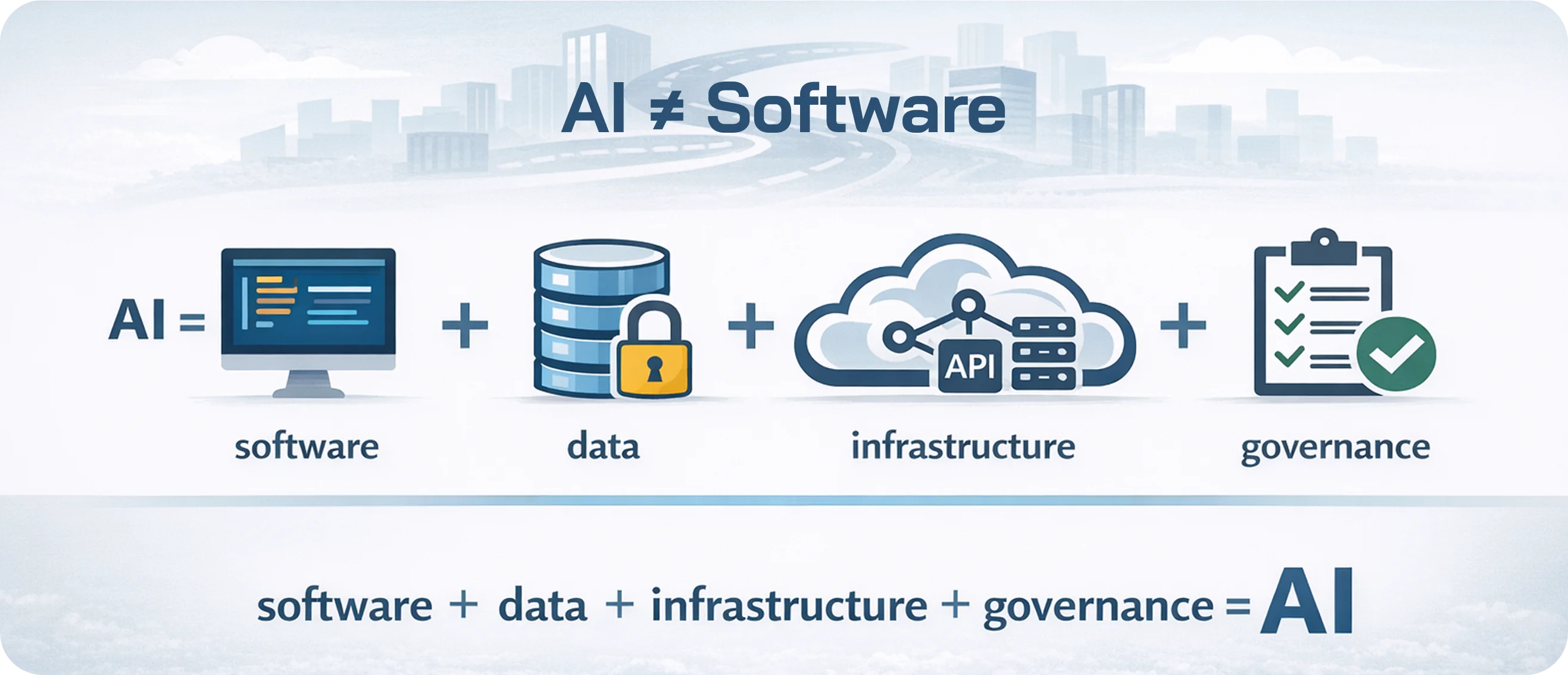
AI succeeds in production only when models, data, infrastructure, and governance are engineered as a single system. This systems-first approach builds on our intent-first product philosophy, where AI is designed around real operational decisions, not abstract model performance.
Whitefox approaches AI as a full-stack engineering discipline. We design robust pipelines that operate reliably in real environments, validation frameworks that scale with growing datasets, deterministic scoring engines aligned with business logic, and cloud-native infrastructure built for continuous operation. Our integration layers ensure AI outputs flow directly into operational workflows, not isolated dashboards.
This systems-first approach is why our work moves beyond experimentation. We don’t deliver standalone models: we architect production AI platforms organisations can depend on.
Conclusion
Partner with Whitefox
Production AI requires more than experimentation. It demands structured platform engineering, robust system architecture, deterministic logic, and infrastructure that performs under real-world conditions.
If your organisation is working with complex, unstructured data and needs reliable, scalable intelligence - Whitefox can architect and deliver the full production AI system. From machine learning pipelines and scoring engines to validation frameworks and cloud deployment, we design solutions that integrate seamlessly into operational environments.
From Prototype to Production AI
If you’re ready to move from prototypes to production AI, let’s discuss your AI system architecture and roadmap.


