
Financial advisor proposal generation software: How AI helps win more clients in 2026

Key Takeaways
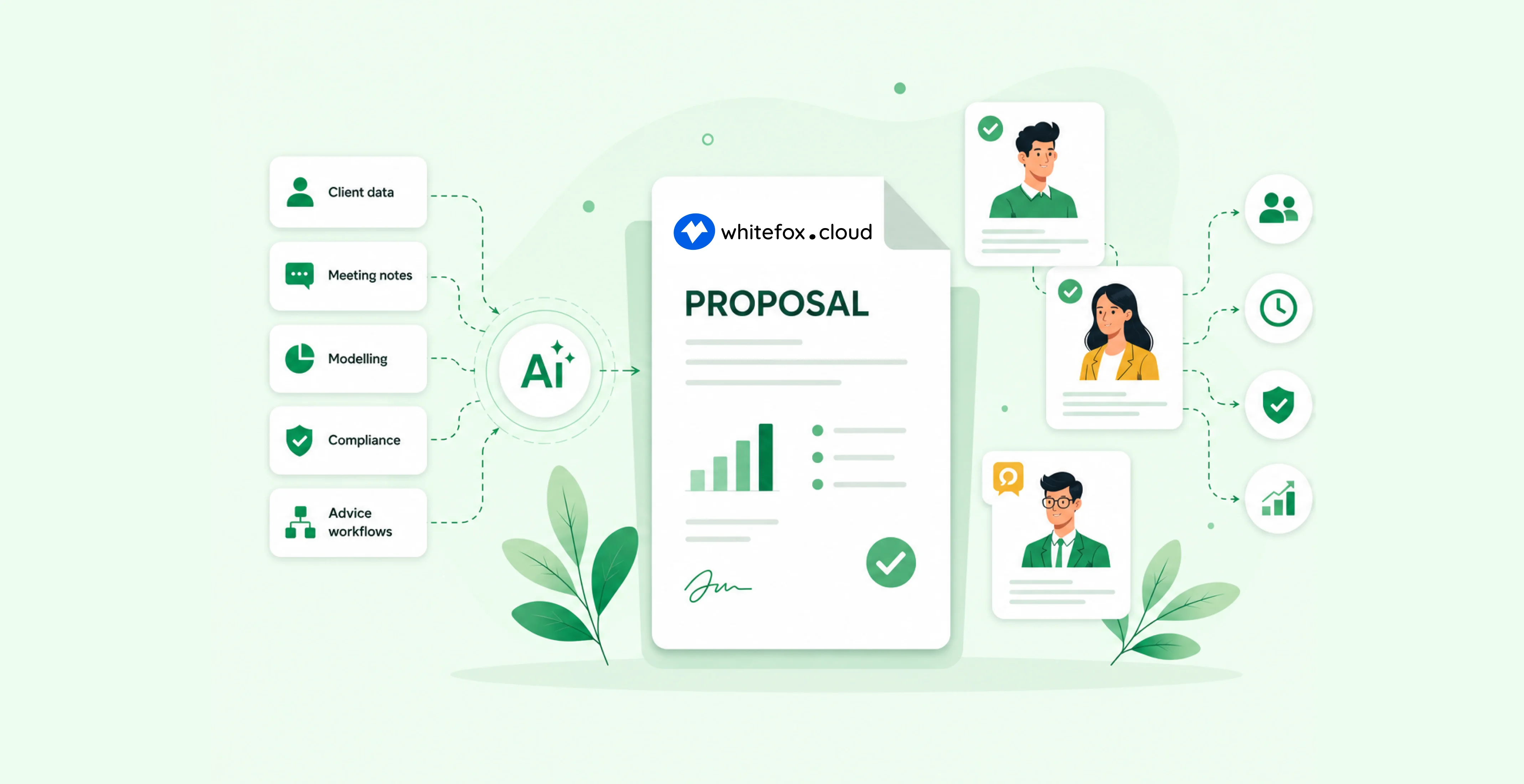
Financial advisor proposal generation software does much more than just producing documents. It connects client data, meeting notes, modelling, compliance and advice workflows into a single process.
The firms seeing the biggest improvements are redesigning proposal workflows, not simply adding AI to document creation.
AI can reduce repetitive administration, improve proposal consistency and help advisers spend more time with clients, provided it is implemented with appropriate governance and human oversight.
Personalised video proposals are emerging as an effective complement to written advice, helping clients understand recommendations more easily.
As advice firms mature, many find that customised proposal workflows provide a better fit than generic off-the-shelf software.
Proposal generation has changed
For years, proposal generation software was largely a document automation tool. Advisers gathered information from meetings, copied data from CRMs, reviewed previous advice, updated financial modelling and manually assembled everything into a proposal template.
AI has changed that: today's financial advisor proposal generation app can understand conversations, retrieve information from multiple systems, suggest content, identify missing information and prepare client-ready proposals in minutes instead of hours. More importantly, it can do this while keeping advisers in control of the advice process.
The biggest opportunity isn't just writing proposals faster: it is creating proposals using information that has already been captured throughout the client journey.
That distinction is becoming increasingly important as financial advice firms face growing client expectations, rising compliance requirements and pressure to improve adviser productivity. Recent research from Deloitte shows that AI is moving rapidly beyond isolated productivity tools toward workflow-aware assistants that support professionals throughout complex business processes, including wealth management.
In our work with financial advice businesses, we've consistently found that proposal generation wasn't the real bottleneck. The underlying workflow was.
What is financial advisor proposal generation software?
Financial advisor proposal generation software helps advisers create personalised client proposals by combining client information, financial planning data, meeting outcomes and business rules into a professional document. In wealth management practices, this is sometimes referred to as wealth management proposal software, since it draws on the same portfolio, planning and compliance data used across the broader advice process.
Traditional proposal software focused primarily on document templates, while new platforms are becoming considerably more capable.
Instead of asking advisers to manually collect information from several systems, AI can retrieve structured data from existing workflows, identify missing information and prepare proposals using the context gathered throughout the advice process.
For example, modern proposal software may combine:
CRM records
Fact Find responses
Meeting transcripts
Financial modelling outputs
Existing client documentation
Compliance requirements
Product recommendations
The proposal becomes the result of an organised workflow rather than an isolated document.
This also improves consistency. When every adviser follows a similar information flow, proposals are less dependent on individual writing styles or administrative habits.
Whitefox.cloud builds custom proposal generation solutions that create advisor proposals as engaging videos or professionally designed PDF presentations. Contact us to discuss your requirements or explore our wealth management software development services .
Why are firms replacing traditional proposal templates with AI?
Because advisers want to spend more time advising clients, not assembling documents.
Template-based systems solved one problem: formatting.
They didn't solve the harder challenges:
Duplicate data entry
Inconsistent information
Repeated rewriting
Manual compliance preparation
Disconnected business systems
AI addresses many of these issues by working with information that already exists.
For example, meeting transcripts can generate structured notes. CRM information can populate client details automatically. Previous recommendations can provide context. Compliance teams can review structured outputs rather than several disconnected documents.
According to EY's latest AI research, financial institutions are increasingly investing in AI to improve operational efficiency while maintaining appropriate governance and human oversight. AI adoption is becoming less about experimentation and more about embedding intelligence into everyday business processes.
That shift is particularly relevant for proposal generation.
Instead of asking: "How can AI write proposals?"
Advice firms are increasingly asking: "How can AI prepare everything required before the proposal is written?" That's a very different question. It moves the conversation from document automation to workflow optimisation.
Why proposal generation starts long before the proposal is written
This is where many organisations discover unexpected opportunities.
When firms first evaluate proposal generation software, they often focus on the final document.
In practice, proposal quality depends on everything that happens beforehand.
A typical advice workflow might look like this:
Client meeting booked >CRM data retrieved > Fact Find completed > Meeting captured > Research and modelling > Recommendation preparation > Quality assurance > Compliance review > Proposal generated > Client presentation
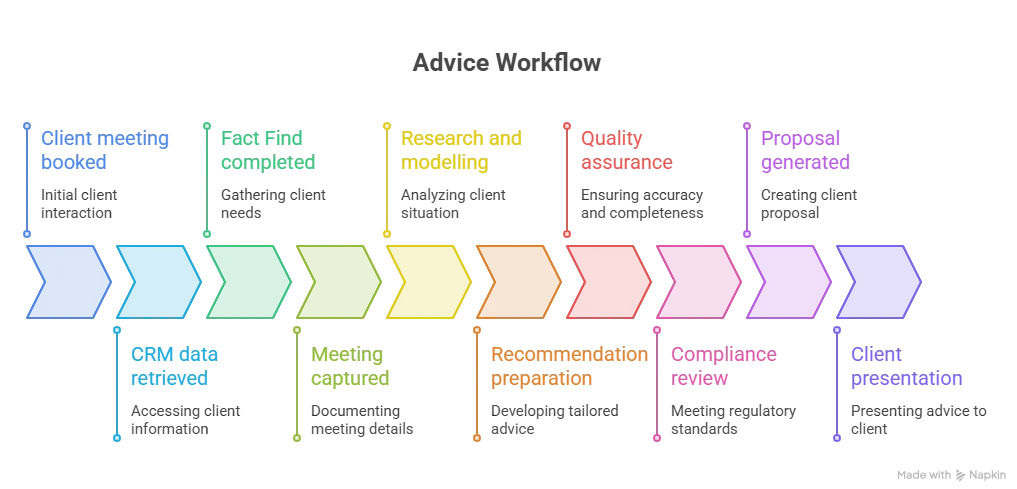
Every stage contributes information that eventually appears inside the proposal.
If those stages are disconnected, advisers spend significant time searching for information, rewriting recommendations or verifying details.
If those stages work together, proposal generation becomes largely automatic.
This is why we often encourage firms to think beyond proposal software alone and examine the workflow surrounding it.
The proposal is only the final output.
The workflow determines its quality.
Hidden bottlenecks we discovered analysing advice workflows
One of the most interesting findings from our work with financial advice organisations was that proposal generation often wasn't taking as long as people believed.
Everything leading up to it was.
When we analysed advice production workflows, several patterns appeared repeatedly:
Advisers were rewriting information already captured elsewhere
Recommendations varied because client information was structured differently between advisers
QA teams spent valuable time correcting inconsistencies instead of reviewing advice quality
Compliance reviewers reconstructed the client's story from several disconnected systems before assessing recommendations
Those activities were rarely measured. Because they happened across multiple systems, they became invisible administrative work.
AI document analytics helped make those bottlenecks visible.
Instead of assuming where time was being spent, firms could see precisely which parts of the workflow created the most effort.
In one implementation, this visibility fundamentally changed automation priorities. Sections everyone assumed were quick turned out to consume far more adviser effort than expected. Once identified, they became obvious candidates for workflow redesign rather than simply faster document generation.
AI document analytics changes what firms optimise
Adding AI to proposal generation before understanding the workflow is a bit like buying faster printing equipment when the real delay is waiting for information from five different departments.
The technology improves one step, but the bottleneck simply moves elsewhere.
That's why many firms are beginning with workflow analytics before introducing AI. Rather than measuring how long it takes to produce a proposal, they measure how information moves through the entire advice process.
Questions like these become much more valuable:
Where do advisers spend the most administrative time?
Which proposal sections are rewritten most often?
Which compliance comments appear repeatedly?
Where does information get copied between systems?
Which client data is requested more than once?
Those insights often reveal opportunities that aren't obvious from looking at proposal software alone.
For example, if meeting notes already contain the information needed for a proposal, AI can extract that information once and make it available throughout the workflow instead of requiring advisers to type it again later.
Similarly, if compliance reviewers repeatedly request clarification on client objectives, proposal software alone won't solve the problem. Improving how objectives are captured during discovery will.
This workflow-first approach is something we've discussed in our article on AI document analytics, where AI helps organisations identify effort before deciding what to automate.
The result is usually better than simply generating documents faster.
It creates a process where information is captured once, validated early and reused consistently throughout the advice lifecycle.
What can AI proposal generation software do in 2026?
Modern financial advisor proposal generation software combines document automation with workflow automation, helping advisers prepare proposals using information that already exists across the business.
Capabilities that were considered advanced only a few years ago are quickly becoming expected features.
Capability | Traditional proposal software | |
CRM integration | ✓ | ✓ |
Template generation | ✓ | ✓ |
Meeting transcription | Limited | ✓ |
Fact Find extraction | Manual | ✓ |
Recommendation drafting | Manual | AI assisted |
Compliance support | Manual | AI assisted |
Quality assurance | Manual | AI supported |
Client video proposal | No | ✓ |
Workflow analytics | No | ✓ |
Cross-system information reuse | Limited | ✓ |
Notice that only one of these capabilities is actually about writing.
Most of them are about understanding, organising and reusing information.
That reflects a broader trend across financial services. Deloitte expects AI agents to increasingly coordinate work across multiple business functions rather than supporting isolated tasks, allowing professionals to focus on higher-value client interactions while AI handles repetitive operational activities.
Introducing Proposal Intelligence
A useful way to think about modern proposal generation is through what we call Proposal Intelligence.
Proposal Intelligence is the ability to generate proposals using the complete context of the advice process rather than isolated client information.
Instead of asking:
"What should this proposal say?"
The software asks:
What do we already know about this client?
What happened during discovery?
What objectives were discussed?
Which supporting documents exist?
Which modelling outputs are available?
Has similar advice been provided previously?
Are there missing pieces that should be resolved before recommendations are generated?
This creates a proposal that reflects the entire advice journey rather than simply combining text blocks.
Proposal Intelligence typically brings together:
CRM information
Meeting Intelligence
Fact Find data
Research
Financial modelling
Advice recommendations
Compliance feedback
Client communication history
The proposal becomes the natural outcome of a connected workflow.
AI supports advisers, it doesn't replace them
One concern that understandably arises whenever AI enters financial advice is whether technology will replace professional judgement.
Current evidence suggests something quite different.
Research across financial services consistently points towards AI augmenting professionals rather than replacing them, particularly in regulated environments where accountability remains with licensed advisers and organisations. Academic studies examining generative AI in financial advice also emphasise the continued importance of governance, explainability and human oversight.
Proposal generation illustrates this well.
AI may prepare:
The first draft
Meeting summaries
Suggested wording
Document structure
Supporting explanations
The adviser still decides:
Whether recommendations are appropriate
Whether assumptions are valid
Whether client circumstances have been interpreted correctly
Whether the proposal reflects professional advice
That balance between automation and professional judgement is likely to remain an important characteristic of advice technology over the coming years.
Proposal generation becomes more valuable when connected to existing systems
One lesson we've learned repeatedly is that proposal software creates much more value when it works with existing business systems rather than replacing them.
Many advice firms already have investments in:
CRM platforms
Financial planning software
Document management systems
Modelling tools
Compliance systems
Client portals
Replacing everything rarely makes sense.
Connecting them often does.
Our own platform, for example, was designed around this principle. Rather than expecting organisations to abandon their technology stack, individual workflow modules can integrate with existing systems through APIs, allowing information to move between discovery, quality assurance, compliance, document generation and client engagement. This gives firms flexibility to improve one workflow at a time or implement a broader end-to-end advice process as their needs evolve.
This also reduces change management.
Advisers continue using familiar systems while AI quietly removes manual administration behind the scenes.
Why personalised video proposals are becoming part of financial advice
Personalised video proposals help clients understand recommendations more easily by combining professional advice with a clear, human explanation.
Financial advice is becoming more comprehensive. Strategies often involve multiple products, long-term planning, tax considerations, insurance, retirement projections and regulatory disclosures. Even a well-written proposal can feel overwhelming for clients seeing it for the first time.
That's one reason advisers are starting to experiment with video alongside traditional written documentation.
Rather than replacing written proposals, video complements them.
For example, an adviser might send:
A written proposal for review and record keeping
A short personalised video explaining the recommendations
Visual highlights of key strategies
A summary of the next steps
Clients can watch the explanation in their own time, revisit it before making decisions and share it with family members if appropriate.
For advisers, this also reduces the need to answer the same introductory questions repeatedly before every presentation meeting.
Our own implementations have shown encouraging results. Across deployments of our platform, personalised AI-generated video proposals have achieved approximately 46% higher conversion than written proposals alone. While every advice business is different, we've consistently observed that clients engage more confidently when recommendations are explained visually as well as documented in writing.
This shouldn't be surprising.
Research continues to show that people absorb complex information differently. Combining written documentation with visual explanation makes it easier for many clients to understand not only what is being recommended, but why.
The proposal becomes less like a technical document and more like a guided conversation.
Off-the-shelf proposal software vs customised workflow automation
Both approaches have their place.
For smaller firms with relatively straightforward workflows, an off-the-shelf proposal solution may provide everything that's needed.
As firms grow, however, they often discover that proposal generation is only one component of a much larger operational process.
Off-the-shelf software | Customised workflow platform |
Faster implementation | Built around existing workflows |
Lower initial investment | Greater long-term flexibility |
Standard integrations | Deep integration with internal systems |
Generic business logic | Organisation-specific workflows |
Vendor feature roadmap | Features prioritised around business needs |
Suitable for many firms | Suitable for more complex operations |
Neither option is universally better.
There is also a middle ground that many firms overlook.
Some software companies can customise an existing platform instead of building everything from scratch. That allows organisations to keep the parts that make them different while avoiding the cost and delivery time of developing an entirely new system.
We often recommend evaluating all three approaches:
Off-the-shelf software with minimal configuration
A platform that can be customised around your workflow
Completely bespoke software built from the ground up
The right option depends on how much of your advice process is unique, how many existing systems need to be integrated, and how much flexibility you'll need over the next few years.
At Whitefox.cloud, we support both custom development and platform-based implementation. We can build a proposal generation solution from scratch or customise an existing platform around your workflows, integrations, and business requirements.
Explore our wealth management software development services or contact our team to discuss the most practical approach for your firm.
When does customised proposal generation become worthwhile?
Customised proposal generation usually becomes worthwhile when proposal preparation depends on multiple systems, repeated manual work or organisation-specific advice processes.
Some indicators include:
Advisers enter the same information into several systems.
Proposal quality varies between advisers.
Compliance teams repeatedly request the same corrections.
Client information is stored across disconnected applications.
Multiple handovers occur between advisers, paraplanners and compliance teams.
Proposal preparation involves significant copying and pasting.
Different business units follow different advice processes.
These situations don't necessarily indicate poor software.
They often indicate that the workflow has evolved over many years while technology has been added incrementally.
That's why we usually begin with discovery and workflow analysis, followed by a technical and business assessment before recommending a solution architecture. In some organisations that leads to implementing selected workflow modules alongside existing systems. In others, a broader platform delivers greater long-term value. The objective isn't to replace technology unnecessarily. It's to remove friction from the advice process.
This also reduces implementation risk.
Instead of redesigning the entire business at once, organisations can improve one workflow, measure the outcome and expand gradually.
A practical checklist for evaluating proposal generation software
If you're comparing solutions in 2026, these questions are worth asking before making a decision.
Workflow
Can it reuse information already captured during discovery?
Does it reduce duplicate data entry?
Can it support different adviser workflows?
Does it fit existing business processes?
Integrations
Can it connect to your CRM?
Does it integrate with financial planning software?
Can it retrieve previous advice?
Does it synchronise information automatically?
AI capabilities
Can it understand meeting transcripts?
Can it identify missing client information?
Can it generate proposal drafts using existing context?
Does it support both written and video proposals?
Governance
Can advisers review every recommendation before delivery?
Is there an audit trail?
Does it support compliance review?
Can outputs be validated before reaching clients?
Looking beyond individual features often leads to better technology decisions.
The most valuable systems don't simply produce documents faster, but improve how information moves throughout the organisation. If you’re interested in one for your company, get in touch with our team or read more about everything we can offer regarding wealth management software .
Conclusion
Proposal generation software has evolved well beyond document templates.
The most successful advice firms are no longer asking how to generate proposals faster. They're asking how to remove unnecessary effort from the entire advice process.
That shift changes the role of AI completely.
Instead of acting as a writing assistant, AI becomes part of a connected workflow that captures meeting information, structures client data, supports recommendation development, assists quality assurance, prepares proposals and improves client communication.
The proposal itself becomes the outcome of a well-designed process.
We've found that organisations often achieve the greatest improvements when they start by understanding how information moves through their business. Once hidden bottlenecks become visible, it's much easier to decide where AI should assist and where experienced advisers should remain firmly in control.
For some firms, an off-the-shelf proposal tool will be enough.
For others, especially those managing multiple advisers, complex compliance processes or several business systems, greater value comes from building proposal generation into a broader workflow designed around the way their business already operates.
If you're exploring ways to modernise proposal generation, it's worth looking beyond document automation alone. A connected advice workflow can improve consistency, reduce repetitive administration and create a better experience for advisers, compliance teams and clients alike.
If you'd like to see how proposal generation fits into a complete AI-powered advice workflow, explore our Financial Workflow Automation solution or read our Effort Lens case study to see how workflow redesign helped reduce advice production time by up to 8× while improving consistency across the advice lifecycle.
Ready to Explore AI in Your Projects?
Let’s talk about how AI models can accelerate your engineering workflows
and unlock new possibilities.
