
Shadow AI Governance & Management: Risks and How to Take Control

An employee has a problem with some code, so they paste it into an AI assistant. A salesperson wants to summarise a customer meeting, so they upload the transcript. A manager needs to analyse a spreadsheet, so they copy it into a chatbot.
Nobody is trying to break company policy. They're trying to get their work done faster.
That's what makes Shadow AI such a difficult problem for business leaders.
AI tools are now so accessible that employees can adopt them in minutes—often without waiting for IT, procurement or security teams.
The uncomfortable question isn't:
"Are our employees using AI?"
It's:
"Do we know which AI tools they're using, what information they're putting into them, and what those tools can access?"
Recent research illustrates the scale of the problem. PagerDuty's 2026 Shadow AI Survey conducted by Wakefield Research among 1,250 office professionals at organisations with at least $500 million in annual revenue, found that 66% had used AI tools at work despite believing those tools were not permitted by company policy.
The same survey reported that 34% had entered customer data into public AI tools, while 31% had entered financial information or confidential company documents or strategies.
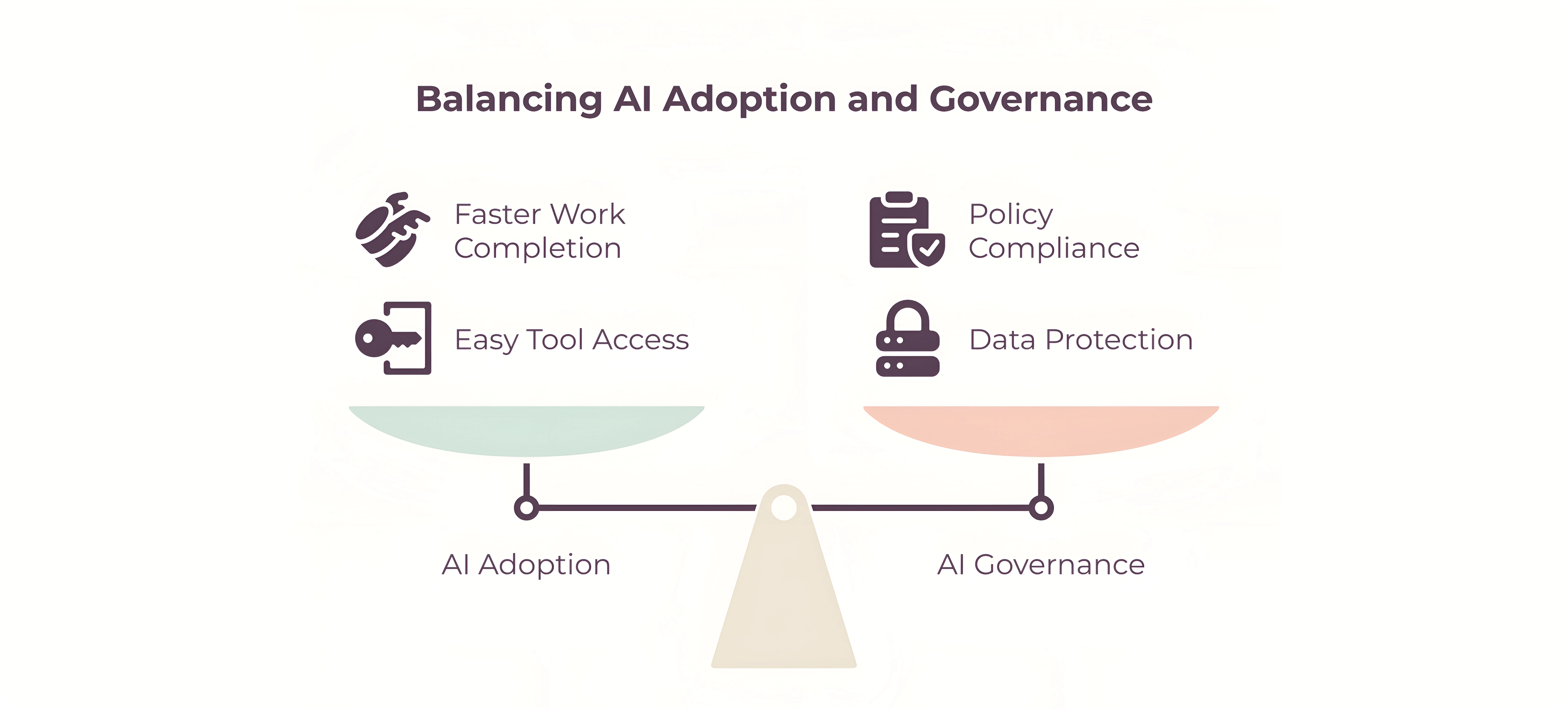
That creates a potentially serious gap between AI adoption and AI governance.
Shadow AI isn't simply employees behaving badly
It's tempting to treat Shadow AI as a compliance problem caused by careless employees. But that explanation misses something important: people use AI because it's useful.
A developer can debug code faster. A salesperson can turn a long meeting into structured notes. A manager can summarise a 50-page document. A customer-service employee can draft a response in seconds.
If the business simply says "don't use AI," the productivity problem that caused the employee to seek AI hasn't disappeared. The employee may simply find another tool.
That's why Shadow AI is better understood as a business governance problem.
The organisation needs to solve two problems simultaneously:
How do we capture the productivity benefits of AI?
and
How do we prevent those benefits from creating unacceptable risks?
What does Shadow AI look like inside a business?
Shadow AI is much broader than someone secretly using a chatbot.
It can include AI features inside tools the company already uses, personal AI accounts, browser extensions, coding assistants and employee-created automations.
Employee behaviour | Why they do it | Potential risk |
Paste source code into an AI assistant | Debug faster | IP exposure |
Upload customer transcripts | Create summaries | Privacy risk |
Upload spreadsheets | Analyse data | Confidentiality risk |
Use a personal AI account | Avoid restrictions | Loss of organisational control |
Install an AI browser extension | Automate tasks | Uncontrolled data access |
Connect AI to SaaS systems | Automate workflows | Unapproved integrations |
Build an AI automation | Remove repetitive work | Unknown credentials and processes |
The common factor isn't the specific AI product. It is the lack of organisational visibility and control.
The biggest risk is often the data
AI doesn't automatically become dangerous because it uses a large language model. The risk depends heavily on what information is being processed and how the system is governed.
Asking an AI tool for ideas for a public marketing campaign is very different from asking it to analyse customer records.
Information | Potential use | Business concern |
Public information | Generate content | Usually low risk |
Internal procedures | Summarise documents | Confidentiality |
Source code | Debug/refactor | Intellectual property |
Customer records | Analyse behaviour | Privacy |
Financial information | Generate analysis | Confidentiality |
Strategic plans | Summarise | Competitive risk |
Employees may see all of these as "asking AI for help." Management needs to recognise that they have very different risk profiles.
Employees may not realise what they're exposing
This is why training alone cannot solve Shadow AI.
An employee might remove a customer's name from a support transcript but leave an account number in the document. A developer might paste an error log into an AI tool without noticing that it contains customer information. A manager might upload a spreadsheet without realising that hidden columns contain confidential information.
There's no malicious intent. The process simply wasn't designed for AI.
This is why businesses need controls that don't depend on every employee making the perfect decision every time.
Why banning AI isn't necessarily the answer
A complete ban sounds simple, but it can create a familiar problem: Shadow IT.
When employees cannot use the tools they need through official channels, they often find alternatives. AI makes this especially easy.
A new service can be created in minutes. An employee can sign up using a personal account. A browser extension can be installed without a conventional software deployment. An API can be connected through a small script.
And the business may never know.
The better question is:
"How do we make the approved way of using AI more useful than the unofficial way?"
That changes the conversation from enforcement alone to governance, enablement and adoption.
Turning useful AI experiments into secure business tools?
We help teams turn proven AI use cases into secure applications, integrations and workflows that fit their existing systems — see our AI software development services.
Shadow AI can reveal where your employees need AI
There's an unexpected opportunity inside the problem.
Shadow AI can show management where employees believe AI can improve their work. If developers are independently using AI to debug code, that may be an opportunity for engineering automation. If sales teams are using AI to summarise calls, there may be an opportunity to integrate that capability into the CRM. If customer-service teams are using AI to draft responses, there may be a candidate for a governed support workflow.
So instead of asking only:
"How do we stop this?"
Ask:
"What problem was the employee trying to solve?"
That question can turn uncontrolled experimentation into an AI roadmap.
The goal isn't necessarily to remove the employee's AI workflow. It may be to build a safer version of it.
The risk gets bigger when Shadow AI becomes an agent
There's an important distinction between an employee using an AI chatbot and an employee creating an AI agent.
A chatbot may expose information. An AI agent can potentially act on information.
Imagine an employee creates an automation that:
Reads customer emails.
Retrieves customer information from the CRM.
Decides how to respond.
Updates the customer record.
Sends the email.
The employee might see this as a productivity experiment. From the organisation's perspective, it is an autonomous system connected to customer data and business infrastructure.
Cloud Security Alliance research found that 82% of organisations had discovered previously unknown AI agents in their environments within the past year.
This is where Shadow AI and AI agent security become closely connected.
The question is no longer only:
"Which AI tools are employees using?"
It becomes:
"Which AI systems are acting on behalf of our employees—and what can they do?"
The visibility gap
One of the concerning findings from recent research is the gap between perceived visibility and actual visibility.
The same Cloud Security Alliance research found that 68% of organisations reported high confidence in their visibility into AI agents, yet 82% had discovered previously unknown agents in the past year.
That doesn't necessarily mean security teams aren't doing their jobs. AI adoption is simply moving faster than many traditional software-governance processes.
A team can adopt an AI feature inside an existing SaaS product. A developer can create an automation using an approved platform. An employee can connect a personal AI account to a business workflow. Traditional software inventories aren't necessarily designed to capture all of these scenarios.
Businesses therefore need to expand their definition of what counts as an AI system.
What should businesses actually control?
A mature Shadow AI strategy doesn't require a blacklist containing every AI website on the internet. It requires control over the things that matter.
Area | Management should know |
Tools | Which AI services are being used? |
Data | What information is being sent to them? |
Identity | Who is using them? |
Access | Which business systems can they connect to? |
Purpose | What problem are they solving? |
Risk | What happens if the AI makes a mistake? |
Ownership | Who is accountable? |
Lifecycle | How is the solution reviewed or retired? |
These questions are more useful than simply asking whether an employee visited a particular AI website.
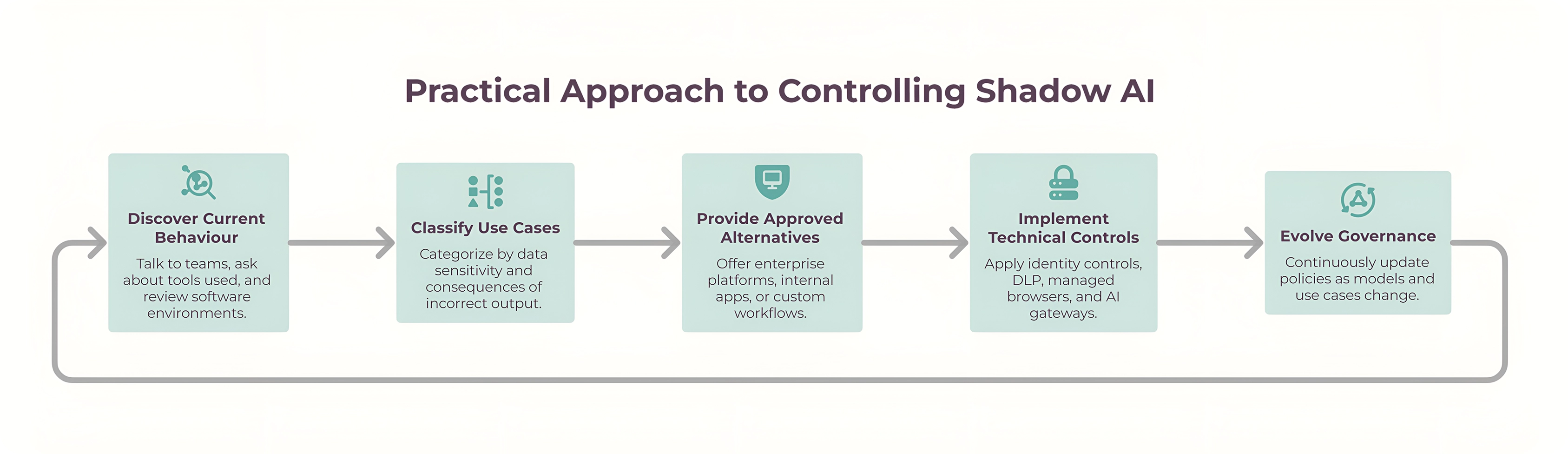
A Shadow AI governance framework: 5 steps to take control
1- Start by discovering what's already happening
Before creating another AI policy, understand current behaviour. Talk to teams and ask which AI tools they use and why. Review software and SaaS environments where appropriate.
The goal isn't to punish employees. It's to build an accurate picture.
2- Classify use cases by risk
Not every AI activity deserves the same level of scrutiny. Generating a public blog headline is very different from processing customer records.
The organisation should classify use cases according to the sensitivity of the data and the consequences of an incorrect output.
3- Give employees approved alternatives
If employees are using AI because it genuinely helps them, provide a supported way to do it. That might be an approved enterprise AI platform, a controlled internal application or a custom AI workflow integrated with existing systems.
The safest AI tool is often the one employees don't have to work around.
4- Put technical controls around sensitive data
Policies should be supported by technology. Depending on the organisation, this could include identity controls, data-loss prevention, managed browsers, access restrictions, AI gateways and monitoring.
The controls should reflect the business risk.
5- Keep governance moving
AI governance cannot be a one-time project. New models appear, existing SaaS platforms add AI features, employees discover new use cases, and AI agents become more capable.
The governance process needs to evolve with them.
Need someone to lead these AI decisions?
A Fractional CTO can help assess AI opportunities, architecture, security and governance without the commitment of a full-time technology executive — explore our Fractional CTO services.
What about businesses without a CTO?
For smaller and growing businesses, Shadow AI can expose a broader technology problem.
Someone needs to decide:
Which AI use cases are worth pursuing?
Which tools should employees use?
What data can be processed?
How should AI connect to existing systems?
Which risks require technical controls?
Which experiments should become production systems?
That doesn't always require hiring a full-time CTO.
This can be particularly useful when AI adoption is moving faster than the company's existing technology governance.
Don't just control AI. Make the right AI easier to use.
This is the central lesson of Shadow AI.
Employees are going to experiment with AI because the technology is useful. Trying to eliminate experimentation entirely may simply push it outside the organisation's visibility.
The better strategy is to create an environment where employees can experiment safely.
That means:
Discover → Evaluate → Secure → Integrate → Govern → Scale
An experiment that proves useful can then become an approved business capability. A salesperson's AI workflow can become a CRM feature. A developer's coding workflow can become an engineering tool. A customer-service experiment can become an integrated support solution.
The difference between Shadow AI and enterprise AI isn't necessarily the model. It is whether the organisation understands, controls and takes responsibility for how that technology is used.
What should management ask today?
You don't need a six-month AI governance programme to start. Ask these questions first:
Question | If the answer is "no" |
Do we know which AI tools employees are using? | Visibility problem |
Do we know what sensitive data enters those tools? | Data-governance problem |
Do we know which AI tools connect to company systems? | Access-control problem |
Do we know which AI agents exist? | Unknown-asset problem |
Does every production AI system have an owner? | Accountability problem |
Can we revoke access when an AI system is no longer needed? | Lifecycle problem |
If several answers are unclear, that's useful information. It means AI adoption may have moved faster than governance.
Shadow AI is a business problem, not just an IT problem
Security teams worry about data exposure. Legal teams worry about privacy and contracts. Compliance teams worry about regulatory obligations. Finance teams worry about uncontrolled technology spending and operational risk. Executives worry about reputation, customer trust and whether the organisation can scale AI safely. Employees worry about productivity.
All of those concerns are legitimate. The solution needs to connect them.
That's why an effective AI strategy should sit across technology, security, operations and business leadership, rather than becoming another isolated IT policy.
Turning Shadow AI into an enterprise AI strategy
The most mature organisations will eventually stop asking:
"How do we stop employees using AI without approval?"
They'll ask:
"What are our employees already teaching us about where AI can improve the business?"
That's a much more useful question.
Shadow AI can reveal real problems worth solving. The opportunity is to take those discoveries and turn them into secure, measurable business capabilities.
When those capabilities need to communicate with CRMs, ERPs, customer portals or other business systems, secure API development and system integration can provide the foundation for connecting AI to existing infrastructure.
And if you're starting from the basics, you can learn more about how APIs allow different software systems to communicate with each other.
Conclusion
Shadow AI is unlikely to disappear because an organisation publishes a stricter AI policy. Employees have already experienced the productivity benefits of AI, and the barrier to trying a new tool is extremely low.
The challenge for business leaders isn't choosing between unrestricted AI and a complete ban. There's a third option:
AI that employees can actually use, inside an environment the business can actually control.
That requires visibility, clear policies, approved alternatives, appropriate data controls and ongoing governance. And it requires understanding that AI adoption isn't just a security problem.
Done properly, it can become a source of new products, faster workflows and competitive advantage.
The biggest Shadow AI risk may not be the AI tool your security team knows about. It may be the one nobody knows exists.
Ready to Bring AI Use Under Control?
Turn useful AI experimentation into secure, governed solutions your team can confidently use.
