
Agentic AI for Startups: How Small Teams Can Do More With Claude

Introduction
Startups often fail because too much important work depends on too few people.
The founder handles customer research. The product lead handles support. The COO builds processes manually. The sales lead writes every follow up. The team moves fast, but the same people keep becoming the bottleneck.
Agentic AI can help. In simple terms, agentic AI is AI that can work toward a goal, follow steps, use context, and help move a task forward. Claude can support these workflows when the task is clear and the boundaries are sensible.
Anthropic has described effective agent systems as often being built from simple, composable patterns rather than unnecessary complexity.
That is good news for startups. They do not need to start with a complex AI platform. They need one useful workflow.
Claude AI Agents Explained
What are AI agents?
An AI agent is an AI model that directs its own processes and tool use when accomplishing a task, deciding for itself how to achieve what users want, rather than following a fixed script.
This makes agents fundamentally different from standard AI assistants. Most people's first experience with AI is reactive: you type a prompt, the AI responds, and the conversation ends. An AI agent does not wait for the next prompt. It takes a goal, determines the steps required, uses the tools available to it, checks its own progress, and moves the task forward - with a human reviewing the result rather than directing every step.
There are two types of agentic systems:
workflows, where LLMs and tools are orchestrated through predefined code paths; and
agents, where LLMs dynamically direct their own processes and tool usage. Workflows are more predictable and consistent. Agents are more flexible and suited to tasks where the steps cannot be fully defined in advance.
For most startups, the right starting point is a workflow, not because agents are too complex, but because a proven, repeatable process is more valuable than a flexible one that has not yet been tested.
What are Claude AI agents?
Claude AI agents are agentic systems built on Claude as the underlying model - meaning Claude is not just answering questions but completing multi-step workflows autonomously within defined boundaries.
In practical terms, a standard Claude conversation helps one person do one task faster. A Claude AI agent runs a connected process: reading inputs, making decisions, using tools, producing structured outputs, and moving work forward. Those tools might include a CRM, a support ticketing system, a document store, or a data warehouse. The human reviews and approves the result rather than directing every step along the way.
The scale of real-world Claude agent deployment signals how seriously enterprises treat this.Today, 70% of Fortune 100 companies use Claude, and many of those deployments are agentic, connecting Claude directly to internal systems, data sources, and business workflows rather than using it as a standalone chat tool.
Claude AI agents — how they work
Anthropic's engineers define agents simply as LLMs autonomously using tools in a loop. The practical sequence looks like this:
Goal input — A human defines the objective: "Summarise all support tickets from this week, categorise by issue type, and flag any that mention billing."
Planning —Unlike generative AI, agentic AI breaks down complex goals into actionable steps before executing anything. Claude determines the steps required rather than just responding to a prompt.
Tool use —The agent integrates with external systems — CRMs, helpdesks, inventory systems — pulling data and triggering actions across channels.
Iteration — The agent checks its own progress and adapts if something does not work as expected.
Output and human review — The agent produces a structured output for human approval. In early-stage startup deployments, this review step is where most of the value is captured — Claude reduces the work, humans retain the judgment.
Anthropic recommends starting with the simplest solution and only increasing complexity when needed. Workflows suit well-defined tasks; agents are the better option when flexibility and model-driven decision-making are needed at scale.
Is Claude agentic AI or generative AI?
Claude is both — and the two are not mutually exclusive.
Agentic AI is not a separate technology from generative AI. The large language model at the centre — Claude, GPT, Gemini — is the same whether used in a chatbot or an autonomous agent. What makes a system agentic is the extra scaffolding: planning, tool use, memory, and autonomous decision-making.
The clearest way to understand the difference: generative AI is the assistant who writes the email. Agentic AI is the system that decides whether to send it, pulls the customer's history to personalise it, sends it at the optimal time, monitors whether it was opened, and adjusts the next touchpoint accordingly.
When you use Claude in a chat window to draft a support reply, that is generative. When Claude reads an incoming ticket, checks your knowledge base, drafts a reply, categorises the issue, and flags it for escalation as part of a connected workflow, that is agentic.
The core tension in agent design is balancing autonomy with human oversight — agents need to work independently to be useful, but humans should retain control before high-stakes decisions are made. For startups, that resolves simply: start generative, prove the output, then graduate to agentic when the team is confident in the process.
Why agentic AI fits startup problems
Startups need leverage before they can afford structure.
A small team may not have:
A large support department.
A full operations team.
Dedicated research staff.
A mature knowledge base.
A large product operations function.
A dedicated automation team.
Agentic AI can help fill the gap by supporting repeatable knowledge work.
It can prepare drafts, summarize inputs, classify tasks, recommend next steps, and create structured outputs that humans can review.
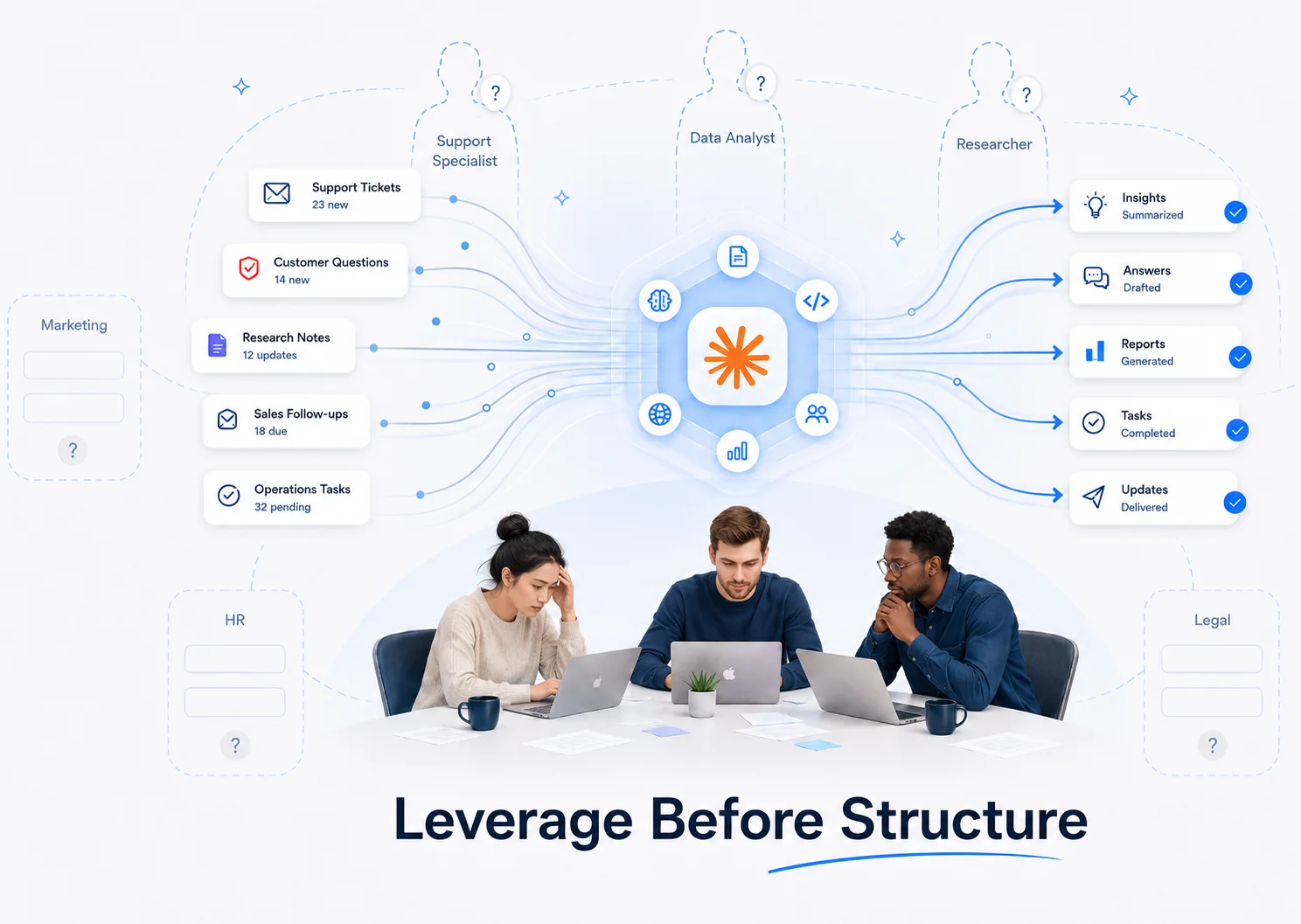
Agentic AI gives startups leverage by helping small teams handle support, research, operations, and reporting before dedicated departments exist.
Agentic AI use cases for startups
Customer support assistant
A Claude powered agent can read a customer ticket, summarize the issue, identify the likely topic, suggest a response, and flag whether a founder or specialist should review it.
This helps a startup respond faster without losing quality.
Research assistant
A startup often needs market research, competitor analysis, customer interview summaries, and sales intelligence.
An agentic workflow can gather notes, organize findings, and produce a decision ready brief.
Sales follow up assistant
After a sales call, the agent can turn notes into a follow up email, CRM summary, next steps, objections, and risks.
This reduces the administrative load around founder led sales.
Operations assistant
The agent can process weekly updates, identify blockers, summarize progress, and prepare leadership reports.
This helps the team stay aligned without long status meetings.
Product feedback assistant
A startup can feed support tickets, customer interviews, reviews, and survey responses into a workflow that identifies themes and feature requests.
This helps product leaders make decisions with more evidence.
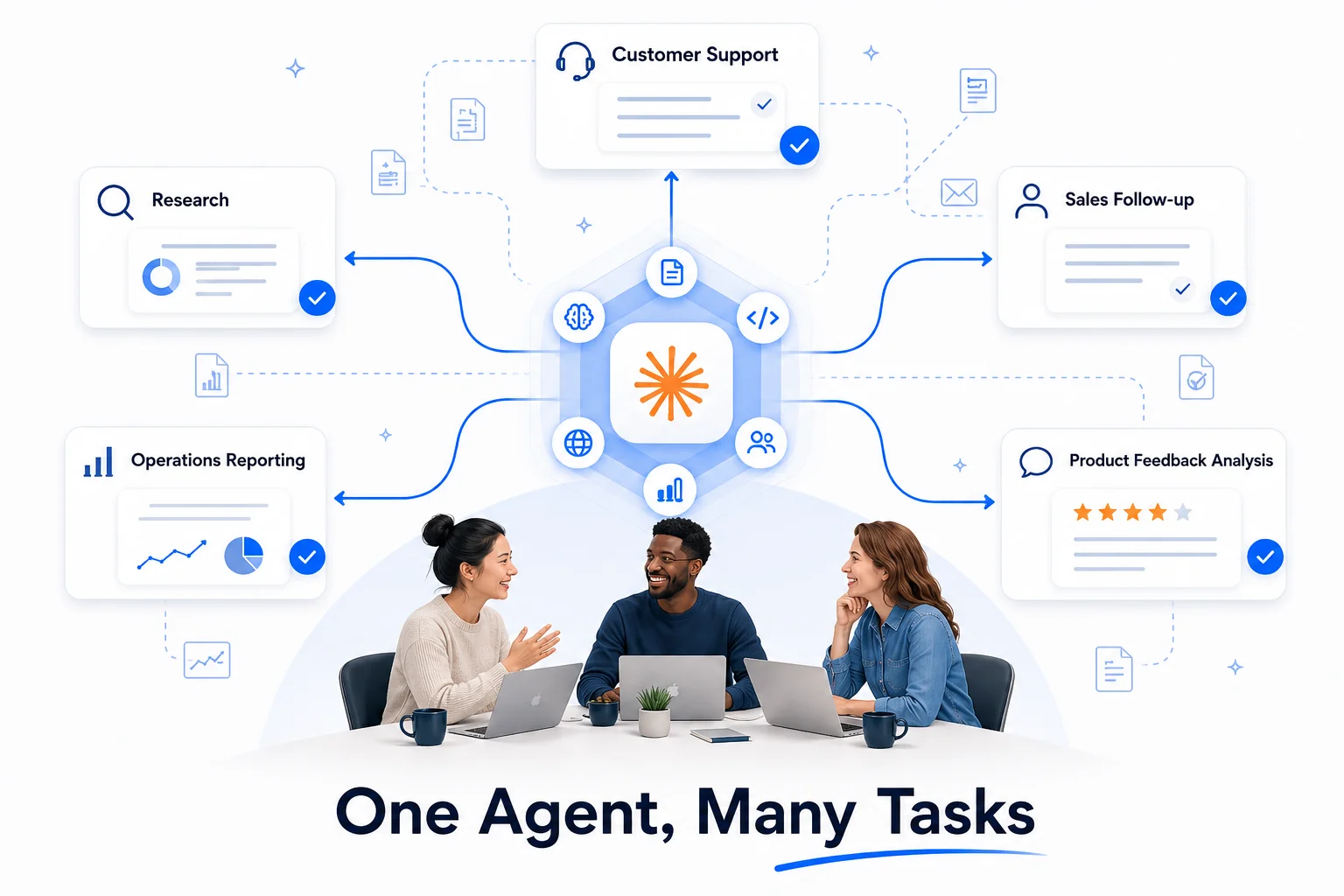
Agentic AI helps startups analyse customer feedback at scale by identifying recurring themes, feature requests, and actionable product insights.
The right first agentic workflow
The first workflow should be narrow.
A good candidate has four traits:
It happens often.
It slows the team down.
The output is easy for a human to review.
Better speed or consistency matters.
Examples include support triage, research briefs, sales follow ups, onboarding content, investor update drafts, and weekly reporting.
What usually goes wrong when startups adopt agentic AI poorly
They start with a giant vision
A founder says, “We want an AI operations manager.”
That sounds exciting, but it is too broad. The first version should not manage operations. It should produce one useful output inside operations.
They automate unstable processes
If the team does not understand the workflow manually, an AI agent will struggle.
Startups should document the current process before automating it.
They ignore quality review
Agentic AI still needs review. A startup should not let AI send customer messages, change records, or make important decisions without human oversight in early stages.
They build before validating
Some startups build custom AI systems before testing whether the workflow is valuable.
It is better to prototype the workflow manually, prove it saves time, then build.
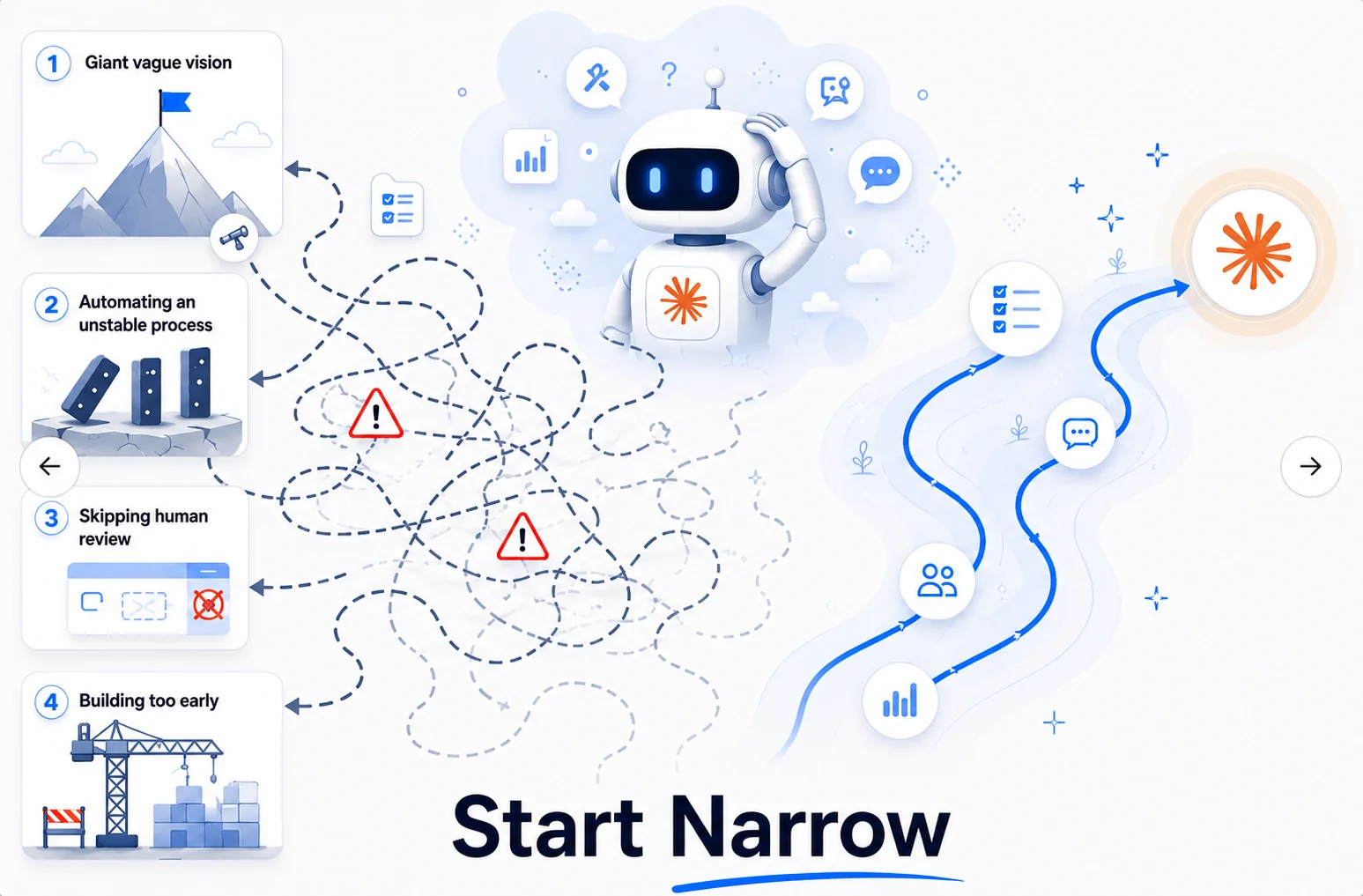
Many startup AI projects fail because teams automate too broadly, skip validation, or build before proving value. Successful teams start with a narrow, measurable workflow.
What a better implementation path looks like
Start with the founder bottleneck
Ask where the founder or senior team keeps being pulled into repetitive work.
That is often the strongest first AI opportunity.
Turn the task into a workflow
Define the input, output, owner, review point, and success metric.
Use Claude as an assistant first
Let Claude prepare the work, then let humans approve.
Build only after proof
Once the workflow works, build it into the company’s tools, CRM, helpdesk, dashboard, or internal platform.
Startups need practical AI implementation, not abstract AI strategy. Whitefox.cloud’s fractional AI CTO services can help founders choose where agentic AI should fit and how to build without creating unnecessary complexity. That support is especially useful when the team needs senior technical judgment but is not ready for a full internal AI department.
Need help building AI agents around your unique workflow?
Whitefox.cloud helps startups and growing companies design, prototype, and implement custom AI agents using Claude and other leading AI models.
Our team was recognised with the AI Leadership Award in the USA, demonstrating our experience in delivering practical AI solutions that solve real business problems.
To see how we have worked with Claude in real-world projects, explore our Claude case study and learn how we approach AI adoption, workflow automation, and agent development.
Practical startup roadmap
Week 1: Find the workflow
Choose one repeated task that consumes founder or operations time.
Week 2: Prototype the output
Use Claude to produce the desired output from real examples.
Week 3: Add review and measurement
Have the team review outputs and measure time saved.
Week 4: Decide whether to build
If the workflow saves meaningful time, consider turning it into an internal tool or product workflow.
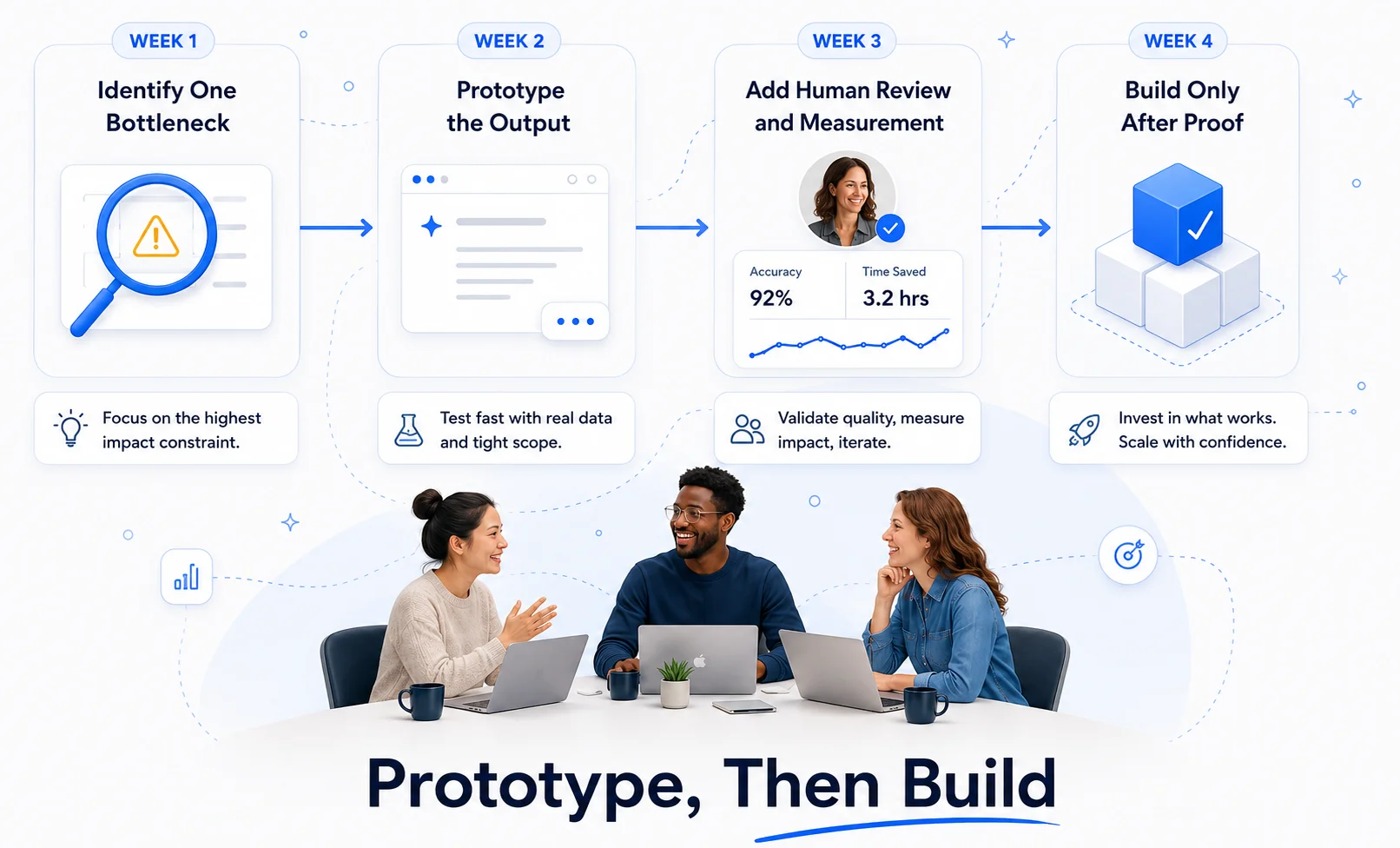
A practical four-step framework for implementing agentic AI in startups, starting with a single bottleneck and scaling only after measurable results are achieved.
Conclusion
Agentic AI for startups should be practical, narrow, and connected to real work.
Claude can help small teams reduce manual effort across support, sales, research, operations, reporting, and product feedback. But the first project should not try to replace a department. It should remove one repeated bottleneck.
For startups, that is often enough to create real leverage.
Ready to Explore AI in Your Projects?
Let’s talk about how AI models can accelerate your engineering workflows
and unlock new possibilities.
