

Claude for Startups: How Lean Teams Can Use AI Without Building a Large AI Department

TL;DR
Startups don't have an AI problem — they have a leverage problem. Claude helps small teams produce more output without building an AI department or hiring specialists early
The right AI strategy depends on your stage — Seed teams need founder productivity, Series A needs repeatable team processes, Series B needs governance and system integration
The best first use cases are already happening in your business every week: customer call summaries, support reply drafts, sales follow-ups, onboarding docs, and product feedback analysis
The four most common startup AI mistakes are building before proving value, automating broken processes, skipping human review, and chasing trends instead of solving real operational pain
You don't need a custom platform to start. A repeatable prompt inside an existing tool beats a three-month build every time
The test for a good first AI project: the work is frequent, involves language or documents, and the output improves speed, clarity, or consistency
When a workflow is proven, then you decide whether to build it into a product, CRM process, or internal tool — not before
Introduction
Startups do not usually have an AI problem. They have a leverage problem.
The founder is handling sales, support, hiring, product direction, investor updates, customer research, and operations. The team is moving fast, but important work is still trapped in calls, notes, spreadsheets, inboxes, documents, and half finished processes.
Claude can help startups create more output from the same team, especially when used for knowledge heavy work. Anthropic positions Claude as useful across professional workflows, including sales, marketing, product management, HR, and team planning.
But startups should not try to build an “AI department” too early. The better move is to use Claude where the team already feels pain: research, support, reporting, customer understanding, sales operations, and internal process creation.
This article explains how startups can use Claude without overcomplicating AI adoption.
How AI adoption changes from Seed stage to Series C
Not every startup needs the same AI strategy. The right approach depends on team size, company stage, and operational maturity.
Series A (10–50 people)
As the company grows, information starts spreading across more people, tools, and processes. What one founder used to hold in their head now needs to live somewhere that ten people can access consistently.
Teams begin to face new challenges:
Knowledge becomes harder to share
Customer communication becomes less consistent
Onboarding new hires takes longer
Reporting becomes more time-consuming
Internal processes start to emerge but are not yet documented
Claude can help create structure by supporting workflows, sales operations, internal documentation, customer research, and product management.
At this stage, AI shifts from individual productivity to repeatable team processes. The question is no longer "how do I move faster?" It is "how does the whole team produce consistent, high-quality output without everything running through the founder?"
The Series A milestone to aim for: At least one AI-assisted workflow that runs without founder involvement - a support triage process, a weekly reporting template, a sales follow-up sequence. That is the signal that AI has moved from personal tool to team infrastructure.
Series B / Growth stage (50–150 people)
This is where AI stops being a productivity conversation and becomes a systems integration problem.
By Series B, you have dedicated teams across sales, support, operations, product, and finance. Each team may already be using AI independently, and that creates a new set of challenges:
Different teams using different tools with no shared standards
AI outputs that are inconsistent across customer touchpoints
No governance over what data AI can access or how outputs are reviewed
Difficulty connecting AI to the CRM, ticketing system, data warehouse, or other core platforms where company knowledge already lives
The priority at this stage is not finding more AI use cases. It is creating the infrastructure that lets AI work reliably across the organisation - with proper access controls, defined review processes, and connections to existing systems.
Claude, combined with Anthropic's Model Context Protocol, allows AI to connect directly to external data sources, tools, and workflows rather than sitting in a separate chat window disconnected from where work actually happens. For Series B companies, that integration layer is often the difference between scattered AI experiments and a system that creates consistent operational value.
The Series B question to answer: Do you have a single owner for AI governance: someone responsible for standards, access controls, quality review, and measuring outcomes across teams? If the answer is no, AI adoption will continue to produce uneven results regardless of which tools you use.
Series C and beyond
The challenges at Series C and above - data governance, enterprise access controls, change management at scale, and connecting AI to complex existing systems - are covered in the Claude for established companies section of this blog.
The short version: larger organisations need more structure before they can move fast. The companies that get this right treat AI adoption as an operational discipline, not a technology project.
Common startup AI mistakes (and what to do instead)
Most startups are not failing to adopt AI. They are failing to adopt it well. Between 70–85% of AI initiatives fail to meet expected outcomes, and 42% of companies abandoned most of their AI projects in 2025 — up from just 17% the year before. For startups, where runway is limited and every project needs to pull its weight, those are costly odds.
The problem is rarely the technology. It is usually one of four avoidable mistakes.
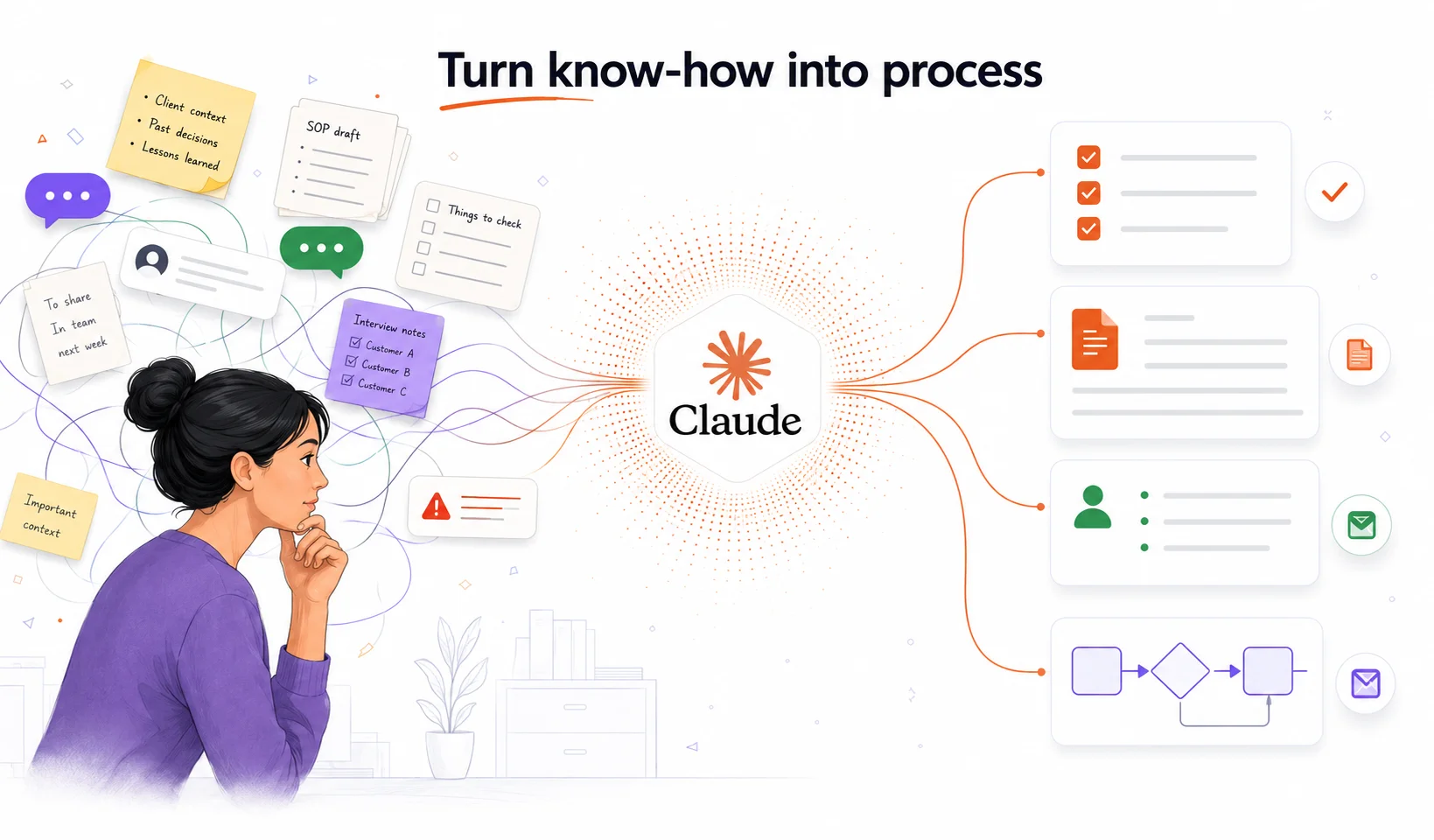
Using AI to turn organizational knowledge into documented processes
1. Building before proving value
A founding team identifies an AI opportunity, spends three months scoping a platform, brings in a developer, and builds something nobody ends up using consistently. This is the most common and most expensive startup AI mistake.
MIT's 2025 State of AI in Business report shows that organisations are eager to adopt AI, but are still figuring out how to move from pilots to full, everyday use. The gap between experiment and operational workflow is where most startup AI projects die.
What to do instead: Pick one task your team already does every week — summarising customer calls, drafting follow-up emails, classifying support tickets — and prove that AI improves it before building anything. A repeatable prompt inside an existing tool is a better starting point than a custom platform. Once the workflow is proven, you can decide whether to build it into an internal tool, CRM process, or customer-facing experience.
2. Automating chaotic processes
AI does not fix a broken process — it accelerates it. A startup that cannot consistently produce a clean sales handover note will not solve that problem by adding AI to the workflow. It will produce inconsistent handover notes faster.
Many AI adopters looking to digitise workflows fail to achieve success mostly due to misplacing AI tools or rushing to adopt them without researching their applications first.
What to do instead: Before introducing AI to any workflow, write down what a good output looks like. For customer research, good output might mean themes, quotes, pain points, objections, and product implications. For support, it might mean issue category, reply draft, urgency, and internal notes. If you cannot describe the ideal output clearly, the process is not ready for automation. Define the standard first, then use AI to help meet it consistently.
3. Expecting AI to replace judgment
A startup founder uses Claude to draft investor update emails and sends them without review. The tone is slightly off, a metric is framed badly, and an investor replies with concern. The problem was not the AI — it was the missing human review step.
Nearly half of organisations surveyed in late 2024 reported worries about AI accuracy and bias as a top barrier to adoption — an issue especially pronounced with generative AI, which can behave like a black box, making it difficult to guarantee outputs are free of bias or error.
Customer communication, hiring decisions, financial reporting, and product strategy all require human sign-off. This is especially important in regulated industries — legal, healthcare, fintech, and compliance-heavy environments where AI errors carry real liability. AI works best as a first-draft engine, not a final decision-maker.
What to do instead: For every AI workflow, define explicitly where human review happens. Start with assisted workflows where a team member reviews output, corrects mistakes, and refines the instructions. Build the review step into the process before you scale it — not after something goes wrong. Full automation can come later, once the workflow is proven.
4. Chasing AI trends instead of solving real problems
McKinsey research suggests that almost all companies are investing in AI, but only one percent believe they are at maturity — and a lot of that stalled progress traces back to projects that started with "we should be doing something with AI" rather than "we have a specific problem AI could solve."
What to do instead: Start with the operational pain point, not the trend. The strongest startup AI projects are unglamorous — automating a weekly report, turning meeting notes into action items, keeping CRM records clean. Features built to match competitor announcements rarely survive contact with real workflows.
Companies using AI technologies show 2.5 times the likelihood of success compared to traditional approaches — but those are startups that connected AI to real workflows, not ones that ran scattered experiments and moved on.
The difference usually comes down to one decision: choosing a specific problem before choosing a tool. Founders often know where the pain is but not how to turn it into a reliable system — that is where Whitefox.cloud's fractional AI CTO services can help, without the cost of a full-time executive hire.
Why startups should think about AI as leverage
For a startup, leverage means doing more important work without adding unnecessary complexity.
Claude can help a small team:
Process more information.
Create better first drafts.
Standardize messy workflows.
Improve customer communication.
Reduce repetitive admin.
Turn founder knowledge into team systems.
The goal is not to replace the team. The goal is to reduce the number of tasks that require a founder or senior person to start from zero every time.
Whitefox.cloud helps startups turn Claude from a useful tool into a repeatable business workflow.
Where Claude can save time first
Customer research
Startups speak with customers constantly, but those conversations often disappear into call recordings, notes, and memory.
Claude can help summarize interviews, extract pains, identify objections, compare segments, and turn raw conversations into product or sales insights.

AI helps teams analyze customer conversations and feedback at scale, uncovering pain points, objections, buying triggers, and product insights without hours of manual review.
A simple workflow could look like this:
Customer call notes go in.
Claude returns key pain points, exact customer language, buying triggers, objections, and suggested follow up actions.
A human reviews the output and adds context.
This helps founders stop relying only on memory.
Support and customer success
Early customers ask similar questions again and again. The team answers manually because the product and knowledge base are still changing.
Claude can help draft support replies, summarize recurring issues, create help articles, and identify which problems should become product improvements.
The business value is faster response without losing founder level context.
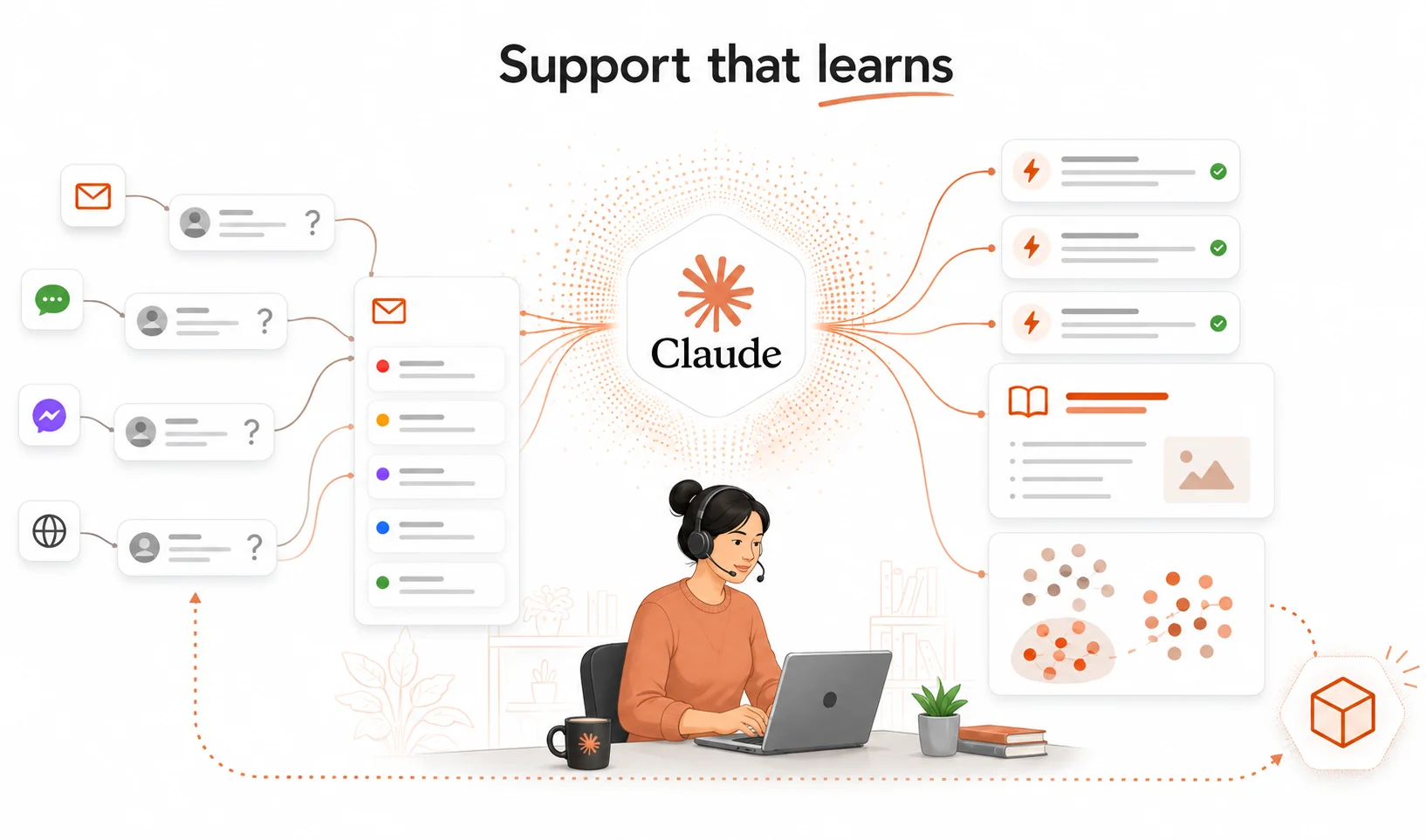
Claude helps startup teams manage customer support more efficiently by drafting responses, identifying recurring issues, and turning support conversations into product insights.
Sales and proposals
Startups often lose time creating custom sales emails, proposal drafts, discovery summaries, and follow up notes.
Claude can help turn discovery notes into structured proposals, draft follow up emails, and prepare short internal deal summaries.
This helps the founder or sales lead stay focused on conversations instead of admin.
Operations and process documentation
Many startup processes live inside one person’s head.
Claude can help turn messy instructions into standard operating procedures, onboarding guides, checklists, and training material.
This is especially useful when the team starts hiring. The faster a startup captures internal knowledge, the less it depends on repeated verbal explanation.
Product management
Claude can help turn customer feedback into themes, feature ideas into user stories, and bug reports into clearer issue descriptions.
This does not replace product judgment. It gives product leaders a cleaner starting point.
AI adoption without hiring a large AI team
A startup does not need a large AI department to begin.
It needs:
A clear business workflow.
A person who owns the process.
A safe way to test outputs.
A review step.
A simple measure of success.
For example, a startup might begin with customer support. The first target could be reducing time spent writing replies by 30 percent while keeping every response human reviewed.
That is a practical AI adoption goal. It is specific, measurable, and connected to real work.
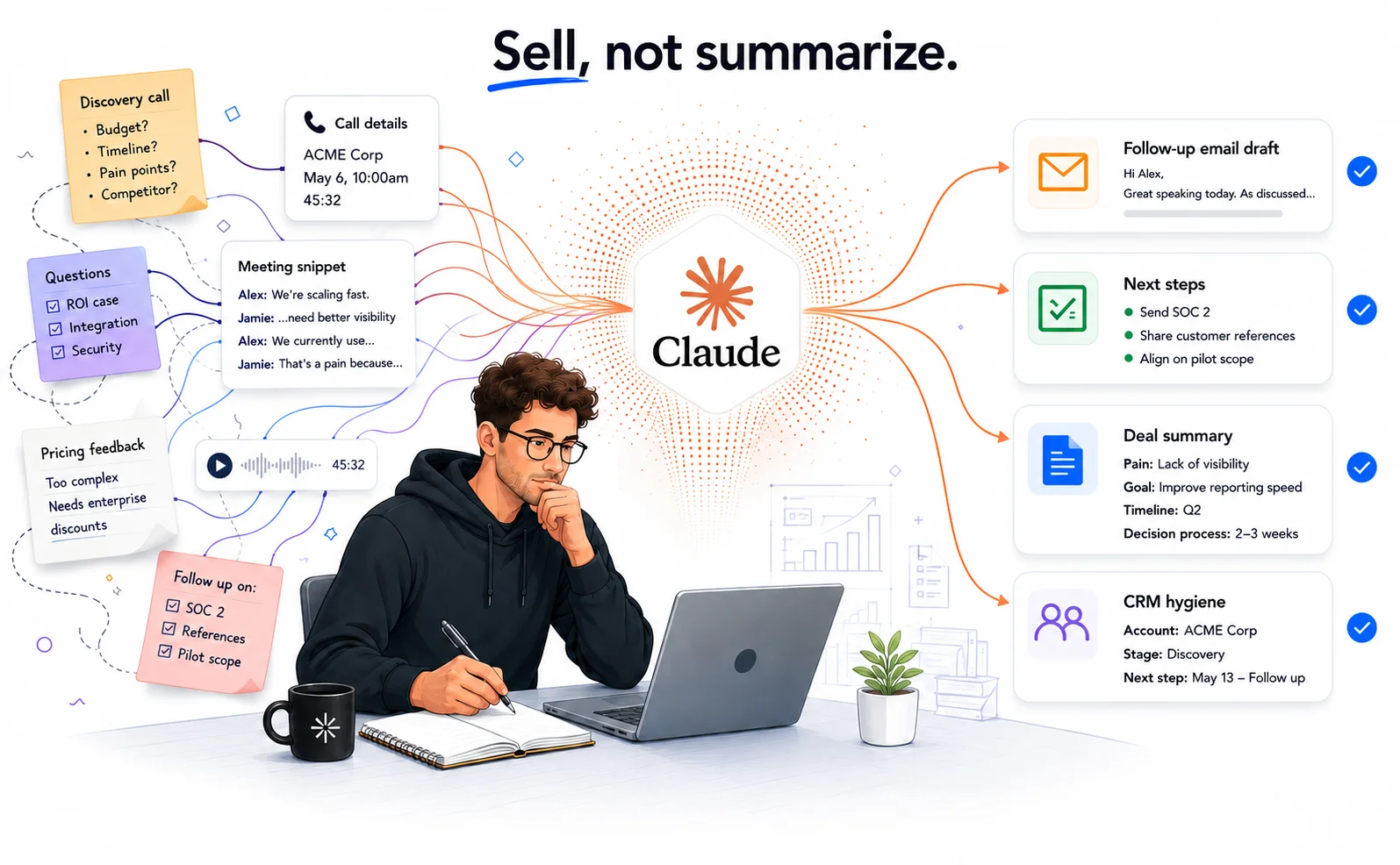
Claude helps founders and startup sales teams turn discovery calls into structured follow-ups, CRM updates, and actionable sales insights.
Practical startup examples
Example 1: Founder led sales
A founder records sales calls and uses Claude to produce a deal summary, objections, next steps, and follow up email draft. The founder edits and sends the email.
Outcome: less admin after calls and better CRM hygiene.
Example 2: Early support team
A support inbox receives repeated questions. Claude drafts answers based on approved help content and flags issues that may need product attention.
Outcome: faster replies and better product feedback loops.
Example 3: Product discovery
The team runs ten user interviews. Claude summarizes each interview, then groups themes across all interviews.
Outcome: product decisions are based on clearer evidence.
Example 4: Internal operations
A startup has onboarding tasks scattered across messages and documents. Claude helps turn them into a structured onboarding process.
Outcome: new hires ramp faster.
Want to move beyond experimentation?
Whitefox.cloud helps startups design and build practical Claude-powered AI workflows.
Explore our Claude case study or learn more about our AI development services.
Why this matters for startup decision makers
Claude for startups is not about following AI hype. It is about increasing the output of a small team.
The best use cases share three traits:
The work is frequent.
The work involves language, documents, or decisions.
The output improves speed, clarity, or consistency.
When those traits exist, Claude can become a practical part of startup operations.
Turn the proven workflow into software
Once the startup knows what works, it can decide whether to build the workflow into an internal tool, SaaS product, dashboard, CRM process, or customer facing experience.
Startups often need both strategic guidance and practical delivery. A founder may know where the pain is but not how to turn it into a reliable system, which is where Whitefox.cloud’s fractional AI CTO services can help shape the technical path. This is useful when the startup wants senior AI and software judgment without hiring a full time executive too early.
Conclusion
Startups do not need a large AI department to benefit from Claude. They need a clear starting point.
Use Claude where the team already feels operational pressure: customer research, support, sales operations, product work, reporting, and internal documentation.
The strongest first AI project is not the most impressive one. It is the one that saves time every week and teaches the company how to use AI responsibly.
Whitefox.cloud helps startups design and build practical AI systems that move from experiment to workflow. For lean teams, that is often the difference between playing with AI and getting real leverage from it.
Ready to Explore AI in Your Projects?
Let’s talk about how AI models can accelerate your engineering workflows
and unlock new possibilities.


Reihaneh Rahmanipour
Reihaneh Rahmanipour


Shima Mehrabi
