
What Is Agentic AI in Insurance? Examples, Benefits and Risks

Insurance companies have spent years digitising their operations. Policy administration, claims management, customer portals, broker platforms, and underwriting systems have replaced much of the paperwork that once defined the industry.
Yet one challenge remains surprisingly common.
Employees still spend a significant part of their day moving information between systems before they can make a decision. An underwriter gathers documents from several sources. A claims specialist checks emails, photographs, policy details, and previous correspondence. Customer service teams search across multiple applications before answering what appears to be a simple question.
Agentic AI aims to reduce this coordination effort.
Unlike traditional AI tools that answer one question at a time, agentic AI can complete several connected tasks within a defined workflow. It retrieves information, follows business rules, uses approved software tools, and prepares work for people who remain responsible for the final decision.
For insurers, the opportunity is not fully autonomous operations. It is creating smoother workflows where routine coordination happens automatically and employees can focus on judgement, customer service, and risk assessment.
What is agentic AI in insurance?
Agentic AI in insurance is an AI system that can plan and complete multiple connected tasks within an insurance workflow. Instead of answering a single prompt, it can retrieve information from different systems, prepare recommendations, request missing documents, and route work to the right team while keeping people responsible for important decisions.
Unlike a chatbot, an AI agent has a goal rather than a single instruction. It understands where it is in a workflow, what information it still needs, and which approved action should happen next.
In insurance, those goals might include preparing an underwriting submission, organising a claims file, or identifying missing documentation before a case reaches an employee.
Why is it called "agentic"?
The word agentic comes from the idea of agency - the ability to work towards a goal rather than simply respond to instructions.
A traditional AI assistant waits for someone to ask a question.
For example:
"Summarise this claim."
It produces an answer and waits for the next prompt.
An agentic AI system behaves differently. Once given a defined objective, it can complete several connected steps within approved boundaries.
For example, an insurance AI agent could:
Read a broker submission
Extract policy and risk information
Identify missing documents
Compare the submission against underwriting guidelines
Prepare a summary for review
Assign the case to the appropriate underwriter
The employee still reviews the recommendation and makes the underwriting decision. The AI handles much of the preparation that happens beforehand.
Agentic AI vs traditional AI
Although both use artificial intelligence, they solve different problems.
Traditional AI | Agentic AI |
|---|---|
Responds to prompts | Works towards a defined goal |
Performs one task at a time | Completes multiple connected tasks |
Waits for user input | Can trigger approved workflow steps |
Produces information | Helps move work through a process |
Limited interaction with business systems | Connects with approved tools and APIs |
This distinction is important because insurance work rarely consists of one isolated task. Most operational processes involve several systems, multiple documents, business rules, approvals, and different teams. Agentic AI is designed to support that type of environment.
How does agentic AI work in insurance?
The easiest way to understand agentic AI is to follow a real insurance workflow.
Imagine a broker submits a commercial insurance application.
Instead of asking an employee to review everything manually, an AI agent could complete the first stage of the process.
Step 1: Receive the submission and supporting documents.
Step 2: Extract customer details, policy information, and risk characteristics.
Step 3: Compare the submission against underwriting requirements.
Step 4: Identify any missing information or supporting evidence.
Step 5: Retrieve relevant policy history or previous interactions through approved APIs.
Step 6: Prepare a structured summary highlighting the main risks and outstanding questions.
Step 7: Route the submission to the appropriate underwriter for review.
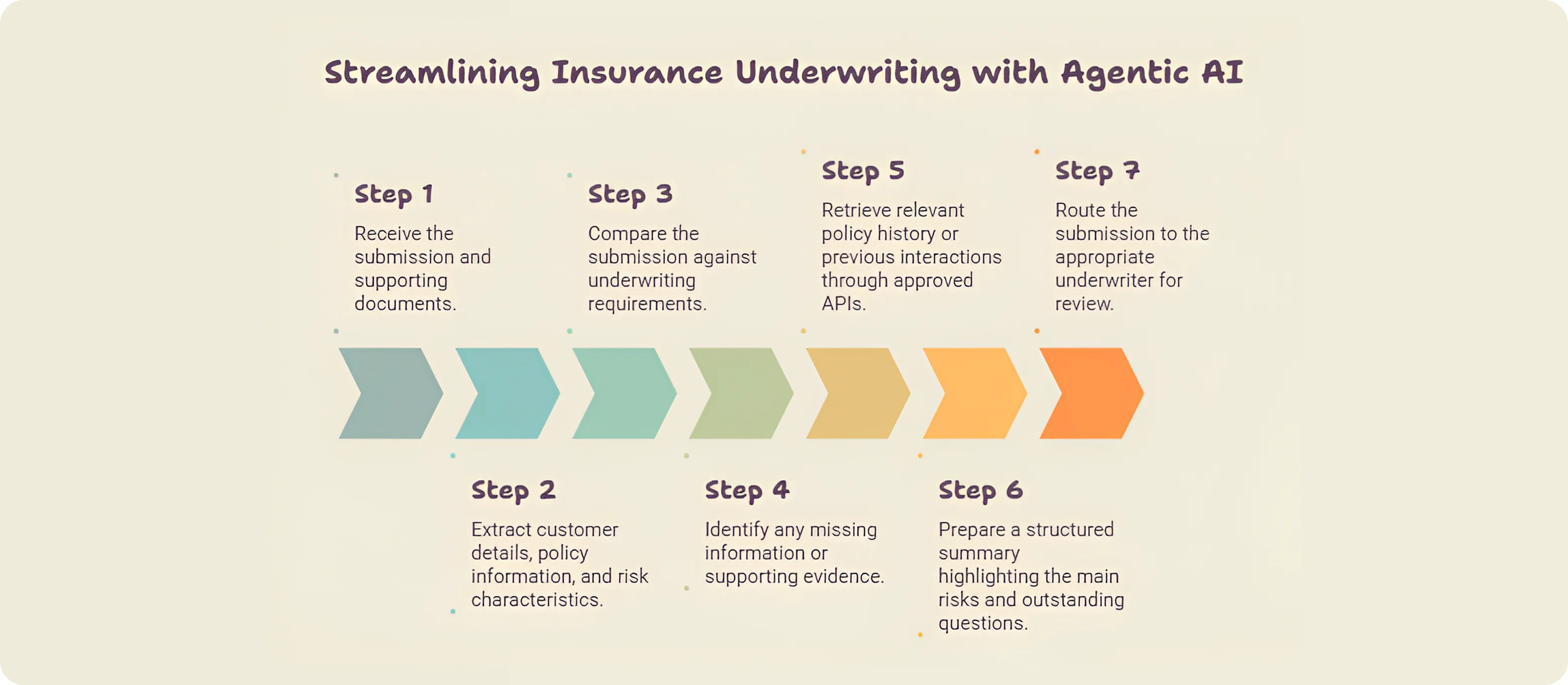
The underwriter still evaluates the risk and approves the outcome. The AI reduces the administrative work required before that decision can be made.
This workflow illustrates an important principle.
The AI is not replacing underwriting. It is helping information move more efficiently through the underwriting process.
Practical examples of agentic AI in insurance
Agentic AI can support multi-step workflows across underwriting, claims, fraud investigation, policy administration, and broker service.
For example, an AI agent can organise underwriting submissions, identify missing information, prepare claims files, flag unusual patterns, compare policy versions, or retrieve submission status for brokers. In each case, the agent handles coordination and preparation, while employees remain responsible for pricing, approvals, investigations, and customer decisions.
For a broader overview of these workflows, see How AI Can Help Insurance Companies: 7 Practical Use Cases.
Benefits of agentic AI in insurance
Most insurers don't invest in agentic AI to replace employees. They invest in it to reduce the operational friction that slows down underwriting, claims, and customer service.
When implemented as part of a well-designed workflow, agentic AI can help insurers:
Reduce repetitive administrative work
Improve consistency across underwriting and claims processes
Shorten response times for brokers and customers
Minimise manual handovers between teams
Make better use of existing data and business systems
Give employees more time for judgement-based work
The biggest gains often come from improving how work moves through the organisation rather than speeding up one individual task.
Agentic AI is not autonomous AI
One of the biggest misconceptions is that agentic AI operates without people.
In production insurance systems, that's rarely the case.
Most agentic AI solutions work within clearly defined boundaries. They can retrieve information, use approved software tools, follow business rules, and complete routine workflow steps. When they reach a decision that requires professional judgement, regulatory interpretation, or customer communication, they hand the work back to a person.
Think of an AI agent as a highly capable operations assistant rather than an autonomous decision-maker.
For example, an AI agent may prepare an underwriting file, identify missing documents, and recommend the next step. It should not decide whether to accept a complex commercial risk.
Likewise, an AI agent can organise a claims file and highlight inconsistencies, but it should not reject a claim without human review.
This distinction is particularly important in insurance, where transparency, accountability, and auditability are essential. Employees remain responsible for decisions that affect customers, compliance, or financial outcomes.
Risks and implementation challenges
Like any enterprise technology, agentic AI depends on the quality of the systems around it.
Many insurers operate across several policy administration platforms, document repositories, CRM systems, and legacy applications. If those systems contain inconsistent or incomplete information, an AI agent may struggle to complete its work accurately.
Common implementation challenges include:
Fragmented data across multiple systems
Inconsistent underwriting or claims processes
Missing or poorly documented business rules
Limited API connectivity between applications
Insufficient audit trails for AI-assisted actions
Unclear governance over permissions and approvals
These challenges are rarely AI problems. More often, they reflect existing operational complexity that becomes visible during implementation.
For this reason, successful projects typically begin with workflow analysis before introducing AI into production.
Building agentic AI on insurance systems
Agentic AI is most effective when it becomes part of an insurer's existing technology landscape rather than another standalone application.
A typical implementation may connect with:
Policy administration systems
Claims management platforms
Broker or customer portals
CRM software
Document management systems
Identity and access management
Internal knowledge bases
External data providers
These connections are usually made through secure APIs, allowing the AI agent to retrieve information, trigger approved actions, and record every step for future auditing.
This means the success of an agentic AI project often depends as much on system architecture, integrations, and governance as it does on the AI model itself. Organisations introducing agentic AI often combine modern insurance platforms with bespoke AI development services to build secure, workflow-aware automation that integrates with existing business systems.
Strong foundations make it easier to introduce automation while maintaining security, compliance, and operational control. Many insurers discover that introducing agentic AI requires modernising or extending their existing platforms rather than simply adding another AI tool. Learn how our Custom Insurance Software Development Services help insurers build AI-ready platforms, integrate core systems, and automate complex workflows.
How insurers should prepare for agentic AI
A common mistake is to begin with the question:
"Which AI model should we use?"
A better starting point is:
"Which workflow creates the biggest operational bottleneck?"
Once that workflow is understood, insurers can determine:
Where employees spend the most time on repetitive coordination
Which systems need to exchange information
Where business rules already exist
Which decisions require human approval
How success will be measured
For many insurers, underwriting preparation, claims triage, or policy administration provide practical starting points because they involve repetitive work, clear business rules, and measurable outcomes.
Starting with one well-defined workflow makes it easier to demonstrate value before expanding AI across additional parts of the organisation.
Conclusion
Agentic AI represents the next step in insurance workflow automation.
Rather than answering individual prompts, AI agents help move work through underwriting, claims, policy administration, and customer service by completing routine coordination tasks across multiple systems.
The greatest value doesn't come from removing people from the process. It comes from reducing the manual work that happens before important decisions are made.
Insurers that achieve the best results typically start with a clearly defined business workflow, reliable system integrations, and strong governance. With those foundations in place, agentic AI can improve operational efficiency while keeping employees responsible for the decisions that matter most.
If you're exploring how agentic AI could fit into your insurance platform, the first step isn't choosing a model, it's understanding your workflows, integrations, and operational bottlenecks. That's where long-term value is created.
Ready to Explore AI in Your Projects?
Let’s talk about how AI models can accelerate your engineering workflows
and unlock new possibilities.
