
Insurance claims automation with AI: how to implement it in practice

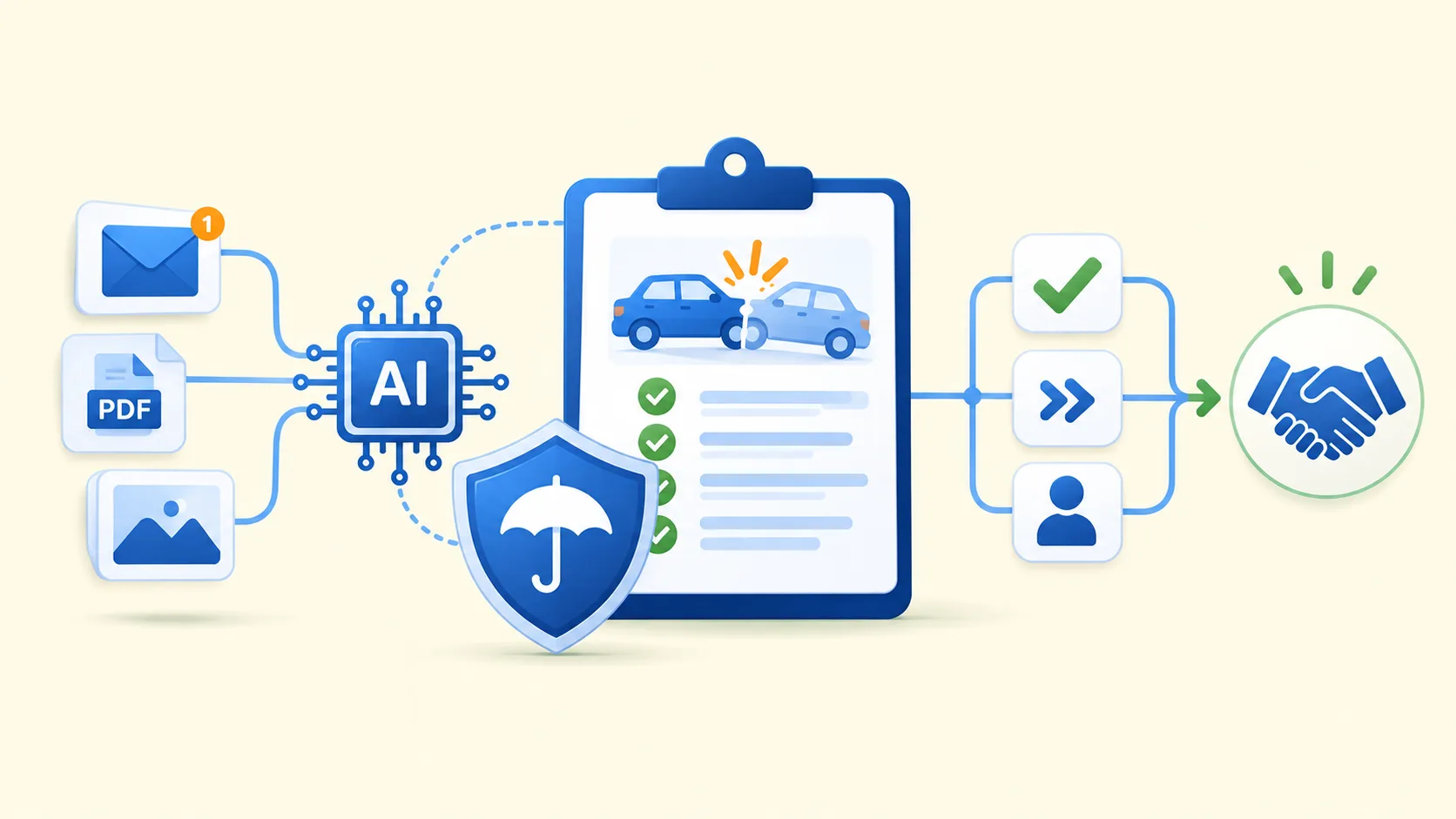
Insurance claims automation uses rules, workflow software and AI to handle the repetitive parts of a claim, such as capturing the first notice of loss, reading documents, checking cover and routing the file. Adjusters then spend their time on judgement. The safest programs automate preparation and routine, low-risk approvals, and keep a person on every adverse decision, such as declining cover or reducing a payment.
This guide is about property and casualty and commercial claims, from first notice of loss to settlement. Health insurance and medical billing claims run under different rules and aren't covered here.
It's a companion to our guide to AI in insurance underwriting and takes the same approach. We go through the claim one stage at a time, say what rules can handle, where AI helps and where a person decides, then cover what to build around the model, what regulators expect and what a sensible first release looks like.
Where claims time goes
Much of the time in a claim goes on the work around the decision:
Re-keying data. Details from the claim form, an email or a phone call are typed into the claims system, then again into a loss adjuster's report or a supplier's portal.
Reading documents. Repair quotes, invoices, police reports, photos and medical or engineering reports arrive in different formats, and someone reads each one to find the few facts that matter.
Manual handoffs. A claim moves between intake, an adjuster, a specialist, a supplier and a manager, and each handoff is a queue.
Status chasing. Claimants, brokers and suppliers ask where a claim is up to, and staff look it up across several systems to answer.
Chasing missing information. Requests go out to claimants, brokers and suppliers for documents or details, followed by reminders when they don't arrive.
This is the work claims automation targets first. It's repetitive, it follows patterns, and when it's done well the adjuster gets a prepared file instead of a pile of attachments.
Rules or AI: what each is good at
Claims automation is usually a mix of two tools. Rules handle conditions you can write down. AI handles material that doesn't arrive as clean data, such as free text, documents and photos.
Rules and workflow | AI | |
|---|---|---|
Best at | Clear conditions you can write down | Unstructured input: emails, reports, photos, notes |
Claims examples | Checking the policy was in force on the date of loss, routing by claim type and value, paying simple claims within set limits, sending status updates | Pulling facts from documents, classifying claim type and severity from a description, flagging inconsistencies for review, summarising a file for the adjuster |
How it goes wrong | Misses cases the rule didn't foresee | Can give a confident wrong answer |
How you control it | Version and test each rule | Test on past claims, monitor results, keep a person on the decision |
In practice, AI turns messy input into structured data, and rules decide what happens next. Decisions on cover and payment stay with rules you can explain and with the people who own them.
Claims automation stage by stage
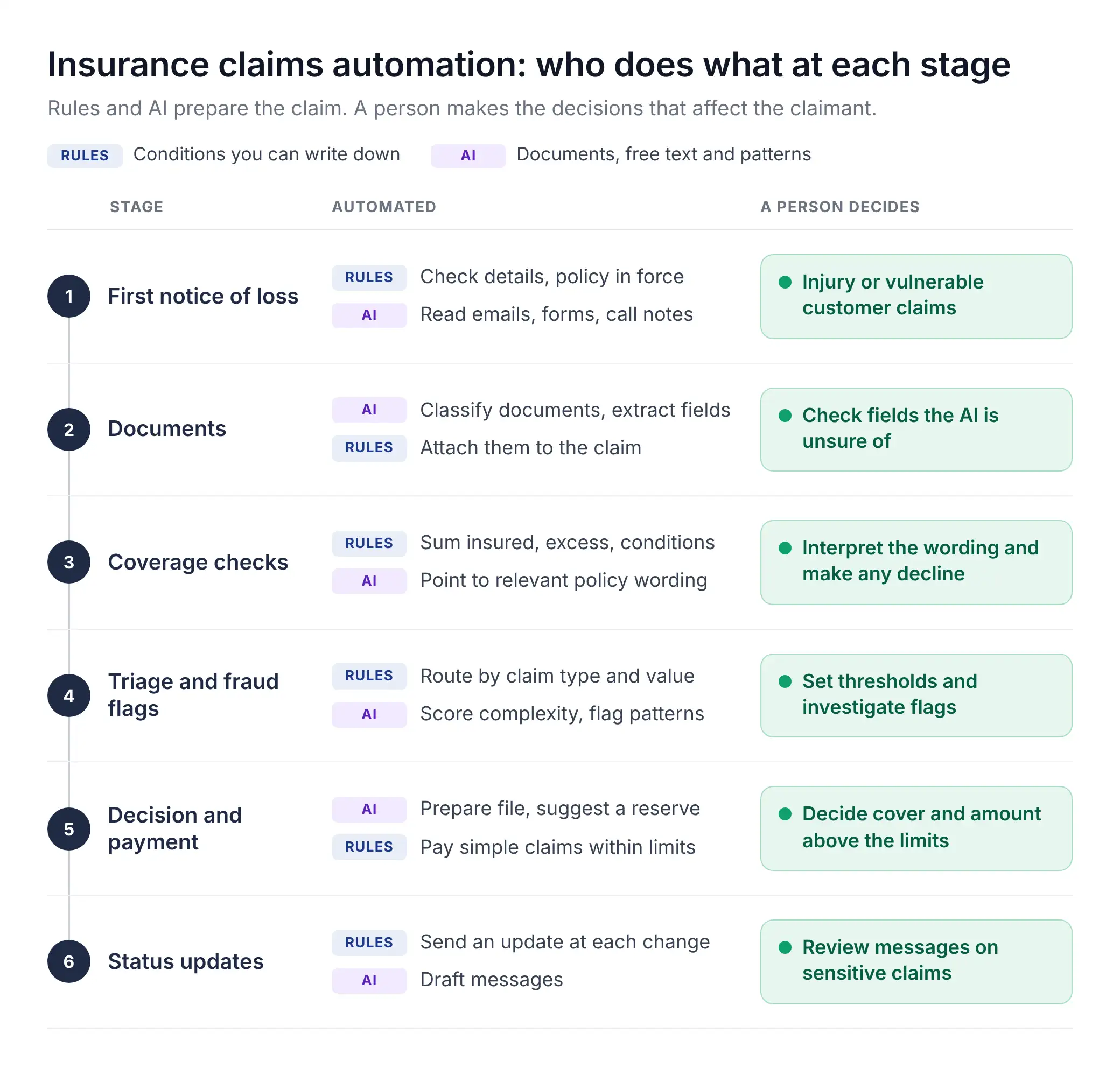
Each stage of a claim has a different mix of rules, AI and human judgement. The diagram shows the split, and the notes below explain each stage.
First notice of loss
Rules check that the required details are there, match the policy and confirm it was in force on the date of loss. A policy in force is only a first check. Whether the loss itself is covered is settled at the coverage stage. AI can read a notification that arrives as an email, a web form with free text or a call transcript, and pull out the date, location, description and parties. Claims involving injury or a customer who needs extra care go to a person straight away.
Documents and evidence
Repair quotes, invoices, reports and photos are where AI can save the most reading time. It classifies each document, extracts the fields that matter and attaches them to the claim. Keep a link from every extracted field to its source document, and send low-confidence fields to a person to check. Check extracted details against the claim and policy data as well, such as dates, amounts and the insured item.
Coverage checks
Where the policy data is structured, rules can check the sum insured, the excess and listed conditions. AI can point the adjuster to the relevant policy wording. When the wording needs interpretation, a person decides, and a model never declines cover on its own.
Triage and routing
Rules route by claim type, value and line of business. AI can add a complexity score from the description and documents, suggesting a fast track, standard handling or a specialist. Claims leaders set the thresholds, and every override of a suggested route is logged.
Fraud indicators
Models can flag patterns worth a closer look, such as inconsistent dates or details that repeat across claims. A flag sends the claim to an investigator for review. It never closes or declines a claim on its own. Expect false positives, and track how many flags lead to a confirmed issue so the model can be tuned.
Reserving support
AI can suggest an initial reserve from similar past claims. The adjuster sets the reserve and can see what the suggestion was based on, so they can check it against the claim's own details.
The adjuster's decision and settlement
Adverse decisions, such as declining cover or reducing a payment, stay with a person, as does any claim outside defined limits. AI prepares the file: a summary, the extracted facts, the relevant wording and any flags. Straight-through payment can suit simple, low-value claims that pass every rule, once eligibility rules, payment limits, exception handling and monitoring are defined. Reviewing a sample of paid claims then checks quality on top of those controls.
Status updates
Automated updates at each change of status cut the calls asking where a claim is up to. For sensitive claims, staff review drafted messages before they're sent.
What to build around the model
The AI model is a small part of a working claims automation system. Most of the effort goes into the foundation around it:
Connections to your core systems. The claims system, policy administration system and payment systems, linked through APIs, so results land where adjusters work and nobody re-keys them.
A rules engine. It applies your limits, approves what qualifies and refers everything else to a person.
Rules under version control. You can change a threshold safely and see which version applied to any past claim.
An audit trail. It records each automated step, each AI output and each human decision, with who, when, and which rule version, model version and settings applied.
Approval points in the workflow. The steps where a person must decide are built into the system, so they can't be skipped.
Which of these parts to buy and which to build is covered in our guide to build vs buy AI in insurance.
Example: the same foundation in underwriting
We built this kind of foundation for Numerisk's Granite, an insurance distribution and quoting platform covering quoting, underwriting rules and referrals, binding and the policy lifecycle. Granite is an underwriting platform, and some of the design principles behind it apply to claims automation too:
A rules engine that supports automatic approval and flagged referral
Underwriting logic under version control, so rules can change safely and earlier decisions stay traceable
An immutable audit trail that logs every action with identity, timestamp and system context.
In a claims workflow, a similar pattern could support straight-through processing for eligible simple claims while everything else is referred to an adjuster, with a record a regulator can follow. Read the Numerisk Granite case study.
Keeping adjusters in control
Claims are where an insurer keeps its promise, so the decisions that affect a claimant stay with people. A few practices keep it that way as automation grows:
Name the decisions a person must make. Declining a claim, reducing a payment, anything above a set value and any claim involving a vulnerable customer. Write them down and build them into the workflow.
Show the reason with every output. An AI suggestion should show what it was based on: the extracted fact, the source document or the rule that matched. An adjuster can't check what they can't see.
Make overrides easy, and log them. A step that adjusters often override is telling you the model or rule needs work.
Check automated outcomes regularly. Review a sample of straight-through claims, and retest when a model or rule changes.
Train the team. Adjusters should know what each automated step does, what it can get wrong and when to step in.
Regulation and fair claims handling
Automating a step doesn't change the insurer's duties to the claimant. Regulators judge the outcome, whoever or whatever produced it. A few examples:
United States. The NAIC Model Bulletin on the Use of Artificial Intelligence Systems by Insurers names claim administration and payment, and fraud detection, among the uses its AI program covers. It states that insurers' actions must not breach unfair trade practices or unfair claims settlement practices laws, which set standards for investigating and settling claims. The bulletin is a model for state regulators, and each state adopts or issues its own requirements. Some states have also considered bills requiring human review of claim denials or payment reductions. Florida's HB 527 passed the House in 2026 but died in the Senate, so it didn't become law.
European Union. The EU AI Act lists insurance AI as high-risk where it's used for risk assessment and pricing of individuals in life and health insurance, so most property and casualty claims tools fall outside that list. Transparency duties can still apply in specific situations. For example, people must be told when they're interacting directly with an AI system, such as a claims chatbot, unless that's obvious to them.
Australia. Claims handling and settling has been a financial service since 1 January 2022, so it must be provided efficiently, honestly and fairly. Under APRA's CPS 230, insurers must classify providers of claims management services as material service providers unless they can justify otherwise. This can include a third party that delivers claims management services using AI. A vendor that only supplies AI software isn't automatically in that group.
These rules point the same way as good practice: explainable steps, people on the decisions that affect claimants, and a record of what happened. This isn't legal advice, so confirm how the rules apply to you with your compliance team.
A realistic first release
Start with one claim type that has steady volume and well-understood rules, such as simple motor or home contents claims. Then build out in this order:
Map the current workflow for that claim type: where the time goes, where data is re-keyed and where claims wait.
Automate intake and document extraction, with adjusters checking every extracted field at first.
Add triage and routing suggestions that adjusters can accept or change.
Run it alongside the current process, compare the results and widen automation only where the evidence supports it.
Add straight-through payment last, for the simplest claims, within limits set by claims leaders.
Each step gives the team something useful on its own, and the foundation from the first release carries the next claim type.
How to measure it
Record a baseline before you start, then track:
cycle time from notification to decision, and to payment
adjuster touch time per claim
the share of claims handled straight through
the override rate on each automated step
the share of claims reopened or corrected after an automated step
leakage, meaning payments above what the policy and evidence support
complaints and disputes, to check that faster handling stays fair.
Plan your first claims automation release
If you’re working out where insurance claims automation fits in your operation, start with one claim type and its workflow.
We can walk through it with you, mark which steps suit rules, AI or a person, and outline a first release with the audit trail and approval points built in.
Ready to Explore AI in Your Projects?
Let’s talk about how AI models can accelerate your engineering workflows
and unlock new possibilities.

Shima Mehrabi

Shima Mehrabi


Reihaneh Rahmanipour
