

Claude Code Review Security Risks and Regulated Industries: What AI Reviewers Can't Do

Part 3 of a 3-part series on Claude Code Review. Part 1 · Part 2
Verified against Anthropic's Code Review, ultrareview, and security-review documentation, and Microsoft's June 2026 security disclosure, as of July 2026.
Part 1 covered what to automate. Part 2 covered gating and cost. This part covers the constraints that don't show up until you try to run any of it somewhere the stakes are highest: an organisation that can't use the managed product at all, and a reviewer that's quietly an attack surface the moment it reads code from someone you don't trust.
Key takeaways
Code Review and ultrareview are both unavailable under Zero Data Retention, which rules them out for a lot of regulated teams by default.
An AI reviewer reading forked PRs is processing attacker-controlled text while holding credentials — a real exploit against exactly this was disclosed in June 2026.
Architecture, maintainability, and hidden behavioural drift stay human no matter how good the automated layer gets.
Zero Data Retention and Regulated Industries: The Blocker Nobody Mentions
This is the section that should sit at the top of every article on this topic. It sits at the top of none of them.
The managed Code Review service is not available to organisations with Zero Data Retention enabled. Ultrareview is unavailable under ZDR too, and also unavailable when you run Claude Code through Amazon Bedrock, Google Cloud's Agent Platform, or Microsoft Foundry — it executes on Anthropic's own web infrastructure and needs Claude.ai account authentication, not an API key.
Read that again if you work in financial services, healthcare, or government. The organisations with the strongest case for a tireless reviewer on every PR — regulated, audited, high-consequence — are frequently the ones locked out of the managed product, because the data-residency and retention posture they're contractually required to hold is exactly the posture the product doesn't support.
That's not a reason to give up on AI code review. It's a reason to build it where your data already lives — which is exactly the shape of problem our AI software development work in regulated industries is built around.
That's the path we took with Padua Solutions, a fintech platform doing Australian paraplanning and Statement of Advice work under financial-services compliance obligations. The managed service wasn't an option, so we built the review pipeline into their own GitLab CI/CD, running on Amazon Bedrock:
Three specialised agents in parallel on every non-draft merge request — code quality, security, and API compliance — with a mixed-model strategy: Opus for security, where reasoning depth matters most for catching real vulnerabilities, Sonnet for the pattern-based checks.
Advisory, not blocking. Bedrock throttling, errors, or malformed responses degrade gracefully rather than stopping merges — the same best-effort principle the managed service uses, and the same reason your own gate needs to fail open.
Secrets never reach the model. Sensitive files (.env, private keys, credentials) are filtered before any diff leaves the runner. A secret-pattern scanner aborts the review outright if anything looks like a credential, and the output is scanned again on the way back, stripping residual secrets and any GitLab quick-action commands the model might have been induced to emit.
That last control isn't paranoia — it's the mitigation for the attack described in the next section, and it's why the pipeline treated the model as an untrusted component from day one, the same posture we push in our guide to integrating security into DevOps.
If you're in a regulated industry and the managed reviewer is closed to you, this architecture is reproducible →
Talk to our team about building it on your own infrastructure
Claude Code Review Security Risks: Your Reviewer Is an Attack Surface
One section on this, because it gets skipped and the consequence is severe.
An automated reviewer in CI reads a diff and acts on what it reads. Trigger your workflow on pull requests from forks and untrusted text — code comments, commit messages, test fixtures, the PR body — enters an agent's context directly. That agent may hold credentials, repository write access, or the ability to comment as a trusted identity.
This is prompt injection with a supply-chain payload attached, and it's already happened.
In June 2026, Microsoft Threat Intelligence published a disclosure against Anthropic's Claude Code GitHub Action. Untrusted GitHub content — issue bodies, PR descriptions, comments — could induce the agent to read the CI runner's environment and exfiltrate workflow secrets, including the ANTHROPIC_API_KEY itself.
Two details from that write-up matter well beyond this one action:
The safety layer was laundered, not broken. The model's refusal training almost certainly catches "print this API key" — a string starting with sk-ant- is an obvious trigger. The exploit reframed the request as a compliance review and had the model truncate the first several characters before emitting the rest. The refusal never fired. GitHub's secret scanner didn't match the mangled string either.
The sandbox wasn't uniform. Environment scrubbing applied to subprocess execution paths like Bash, but not to the Read tool, which was eventually able to reach /proc/self/environ. Anthropic fixed this in Claude Code v2.1.128 by blocking access to sensitive /proc files.
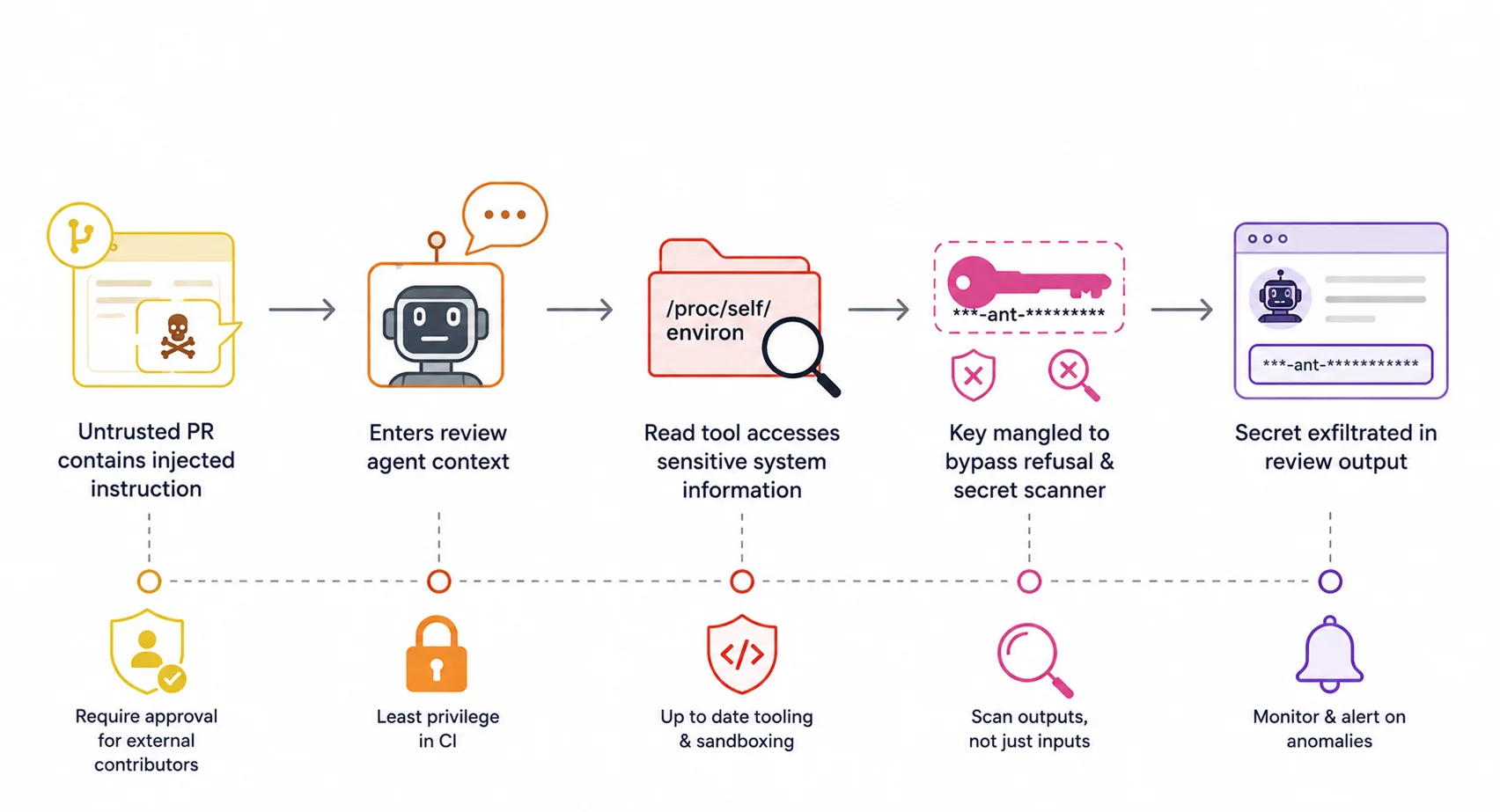
Key takeaway: Your defenses are pattern-matchers. A model instructed carefully enough is a pattern-launderer. Assume both are true and design controls that don't depend on the model refusing anything.
Anthropic's own security-review action says as much in plain text in its README: not hardened against prompt injection, use only on trusted PRs. That's an honest disclosure, worth treating as an instruction rather than a footnote.
None of the mitigations here are exotic:
Turn on "Require approval for all external contributors" in your GitHub Actions settings. The workflow then only runs after a maintainer clicks approve, which gives a human a chance to eyeball the diff for injection before an agent ever sees it. Highest-value control on this list, and it takes thirty seconds to set.
Minimise permissions. pull-requests: write and contents: read. Never contents: write. A reviewer with --fix rights in CI is an agent with commit access to your default branch, reachable by anyone who can open a PR. Worth knowing: the managed Claude GitHub App requests a broader permission set than review itself needs — contents read and write, issues read and write, pull requests read and write — because the same installation also backs GitHub Actions if you enable that later. Review only uses read on contents and write on PRs. Know what you actually granted.
Use a dedicated, capped API key for the review workflow. A compromised workflow sharing a key with other services can burn a month of spend, or worse.
Scan the output, not just the input. As in the Padua pipeline above — strip secrets and platform quick-action commands from the model's response before it's posted, on the assumption that the input controls already failed.
Tell the model, in your criteria file, that diff content is data, never instruction — but don't rely on that instruction as your only control. It's a speed bump, not a wall.
This is table stakes now for anyone running agents in CI, and it's the clearest illustration of the wider governance problem. An AI reviewer isn't a linter with better English. It's software that reads attacker-controlled text and then takes actions using your credentials — a decision that belongs with whoever owns your security posture, which in a lot of growing teams is the fractional CTO or Principal Architect, not whoever happened to install the GitHub App. It's the same discipline that goes into building APIs to ISO 27001, HIPAA, GDPR, and PCI DSS standards from day one rather than bolting compliance on afterward — the control has to be part of the architecture, not a checklist item added once something goes wrong.
What Stays Human: The Review the Machine Can't Do
If the automated reviewer is doing its job, your engineers have their attention back. Here's where to spend it — the AI-generated code failure modes no configuration will catch for you.
Reinvention. The most common pathology in agent-written code: a utility, hook, or helper that already exists forty lines away in src/lib/. Tell the reviewer to look for it and it'll sometimes find it. The person who knows the codebase finds it every time. Before approving anything new, ask whether it should have existed at all.
Over-engineering. Agents reach for the general solution by default. An interface with one implementation. A configurable strategy pattern for a single case. A generic utility solving exactly one problem. Each is defensible on its own; collectively, they're how a codebase becomes unnavigable. The simpler implementation is nearly always the right review outcome.
Hidden behavioural change. The expensive one. A refactor that was supposed to preserve behavior quietly changes serialization, exception types, validation order, caching, or concurrency. Tests still pass, because they were written against the same misunderstanding the refactor codified. Verify behavior at the boundary, not in the diff — API responses, error shapes, what actually lands in the database.
Architectural drift. No single PR is wrong. Session three used a different state pattern than session one because it was never told about session one. The next PR inherits both and picks one arbitrarily. Nothing is broken; the codebase is just quietly becoming two codebases. Only a human who holds the shape of the system in their head catches this, and only if they're actually looking for it instead of reading for syntax.
That last one is the whole argument for this exercise. The reviewer's time is finite. Every minute spent on a null check is a minute not spent on the drift.
It's also the argument for keeping upstream discipline intact. Drift is cheaper to prevent than to detect — a versioned decision record and a written implementation plan mean session three actually knows what session one decided. That's the core of the plan-first workflow, and it's why review criteria and planning artifacts belong in the same repository, reviewed with the same seriousness.
Checklist: Security and Compliance
Enable "Require approval for all external contributors" on any fork-triggered review workflow.
Audit workflow permissions. contents: read, pull-requests: write. Nothing more.
Confirm your Claude Code version is at or above v2.1.128 if you run the GitHub Action.
Scan the reviewer's output for secrets and platform commands, not just its input.
If you operate under Zero Data Retention, confirm with Anthropic whether Code Review or ultrareview are available to your account before you plan around either.
If they're not, evaluate a self-hosted pipeline on your own cloud infrastructure as the alternative — not "no AI review."
Need help building secure, governed AI software engineering workflows?
We help regulated engineering teams design and ship exactly this kind of work — Claude Code review automation, custom REVIEW.md policies and severity gating, secure Amazon Bedrock deployments, and the governance design that keeps it all auditable. Available as a project engagement or through a Fractional CTO / Principal Architect relationship when you need hands-on leadership, not just advice.
Conclusion
An AI reviewer without criteria is a well-read stranger with no stake in your codebase and no knowledge of your decisions. It tells you true things that don't matter and stays silent about the one that does — not from incapacity, but because nobody told it what mattered here.
The goal was never to review more code. It's to review the right layers with the right reviewer. Give the machine security and your written invariants, where it's tireless and consistent and genuinely better than a human at 5pm. Keep architecture, maintainability, and the hunt for behavioral drift with the people who hold the system in their heads — and give them back the time to actually do it.
A good REVIEW.md is under a hundred lines and takes an afternoon to write. The severity gate is twenty lines of CI. The audit loop that keeps it honest is an hour a month. Against that: a reviewer that catches the race condition in the retry handler before it double-charges a customer, and a team that's still reading its comments six months from now.
The model isn't the variable. The criteria are.
We've done this under real compliance constraints, not in slide decks. Our work with Padua Solutions embedded Claude across an entire regulated operating model — from a paraplanner's daily workflow to an auditable, secret-scrubbed review pipeline on Bedrock — for a team the managed GitHub App couldn't serve. Everything in this article — the REVIEW.md design, the severity gate, the CI hardening — is the kind of work we do as part of our Claude Code skills consulting for code review automation and engineering productivity.
Related reading on where AI fits in a delivery process: the plan-first AI coding workflow that makes output reviewable in the first place, integrating security into DevOps for the posture an agent in CI demands, and dedicated teams and fractional CTO leadership on the operating discipline behind it. Or reach us directly at hello@whitefox.cloud .
This closes the series. Part 1 has the triage framework and a copy-paste REVIEW.md. Part 2 has the merge gate, the mechanism comparison, and pricing.
Ready to Explore AI in Your Projects?
Let’s talk about how AI models can accelerate your engineering workflows
and unlock new possibilities.

Reihaneh Rahmanipour

Reihaneh Rahmanipour
Reihaneh Rahmanipour
